
You have a brightening serum. You use it every day. And yet those dark spots keep coming back, or they fade slowly, or they never quite disappear.
If this sounds familiar, the issue probably isn't your serum. Most brightening serums are built to work downstream, fading pigment after it has already formed. But what if the signals telling your skin to make that pigment were never addressed?
That is the question Exo-PDRN Prismatic+ is built to answer. This post explains how it works, why it pairs so well with a brightening serum, and what that means for your skin over time. If you are in the research phase and trying to decide whether this product belongs in your routine, this is the clearest explanation we can give you.
Why Does Pigmentation Keep Coming Back?
Most people treating dark spots focus on the spots themselves. That makes sense. The spots are visible, and fading them feels like progress. But pigmentation is not just a surface event.
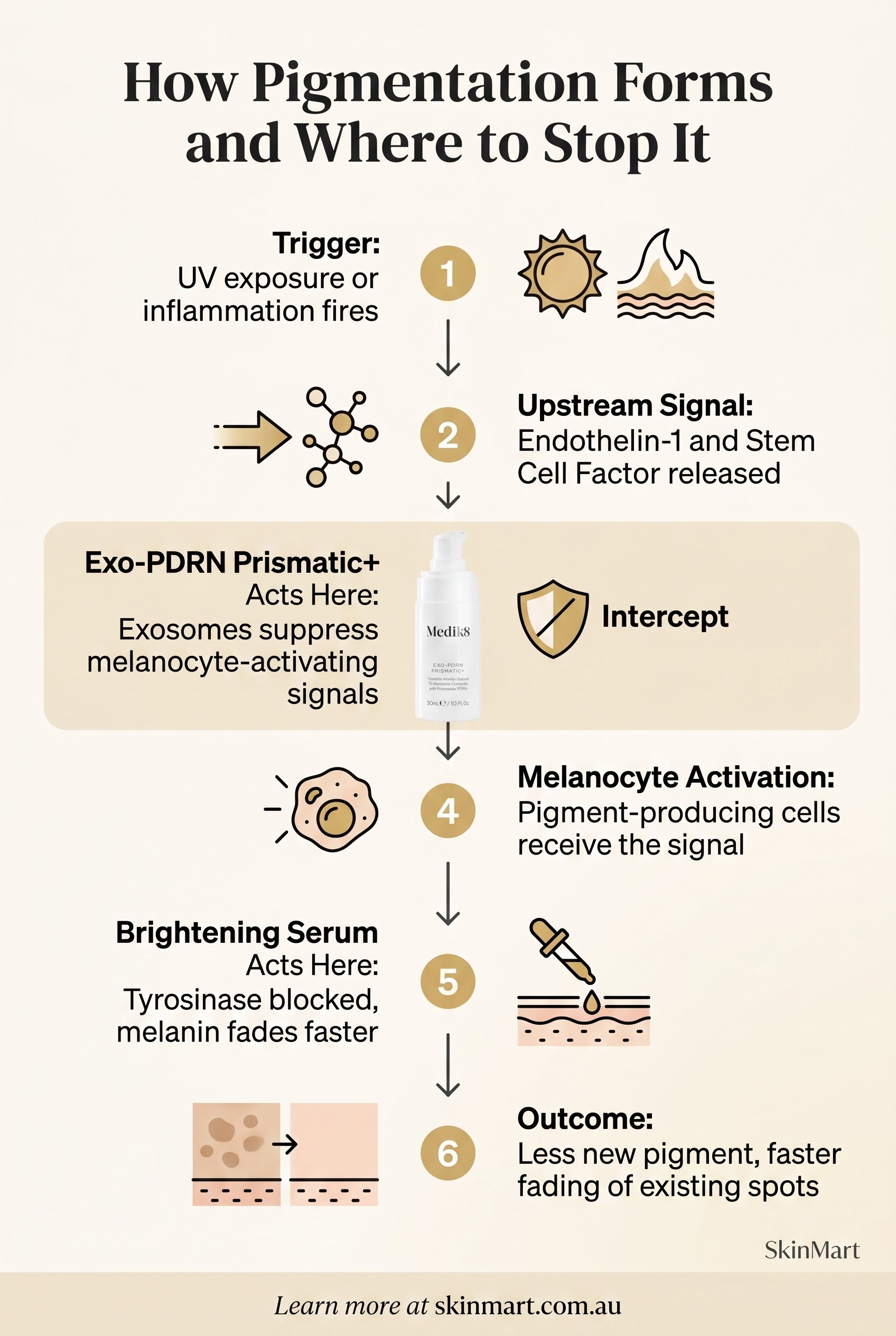
It starts with a signal, deep in your skin, that tells specialised cells called melanocytes (the cells that produce skin pigment, called melanin) to become more active. When those signals stay elevated, your skin keeps producing excess pigment. Fade one spot, and another forms. The cycle continues.
Two key signals drive this cycle: Endothelin-1 and Stem Cell Factor. Both are proteins that your skin releases in response to inflammation, UV exposure, or hormonal shifts. They travel to your melanocytes and essentially say, "produce more pigment." If you are only treating the pigment itself, you are working downstream. The signals upstream are still firing.
This is why pigmentation can feel so stubborn. It is not that your brightening serum is failing. It is that the system producing the pigment has not been addressed. Treating both levels at once changes the outcome.
Key Takeaways
- Exo-PDRN Prismatic+ works with your brightening serum by targeting the upstream signals that tell your skin to overproduce pigment in the first place.
- Most brightening serums work downstream, fading spots after they form.
- Exo-PDRN Prismatic+ uses a Triple Exosome Complex and Prismatic PDRN to suppress melanocyte-activating signals like Endothelin-1 and Stem Cell Factor before they trigger excess melanin.
- This two-level approach means your brightening serum has less pigment to fight, and your...
What Does Exo-PDRN Prismatic+ Actually Do?
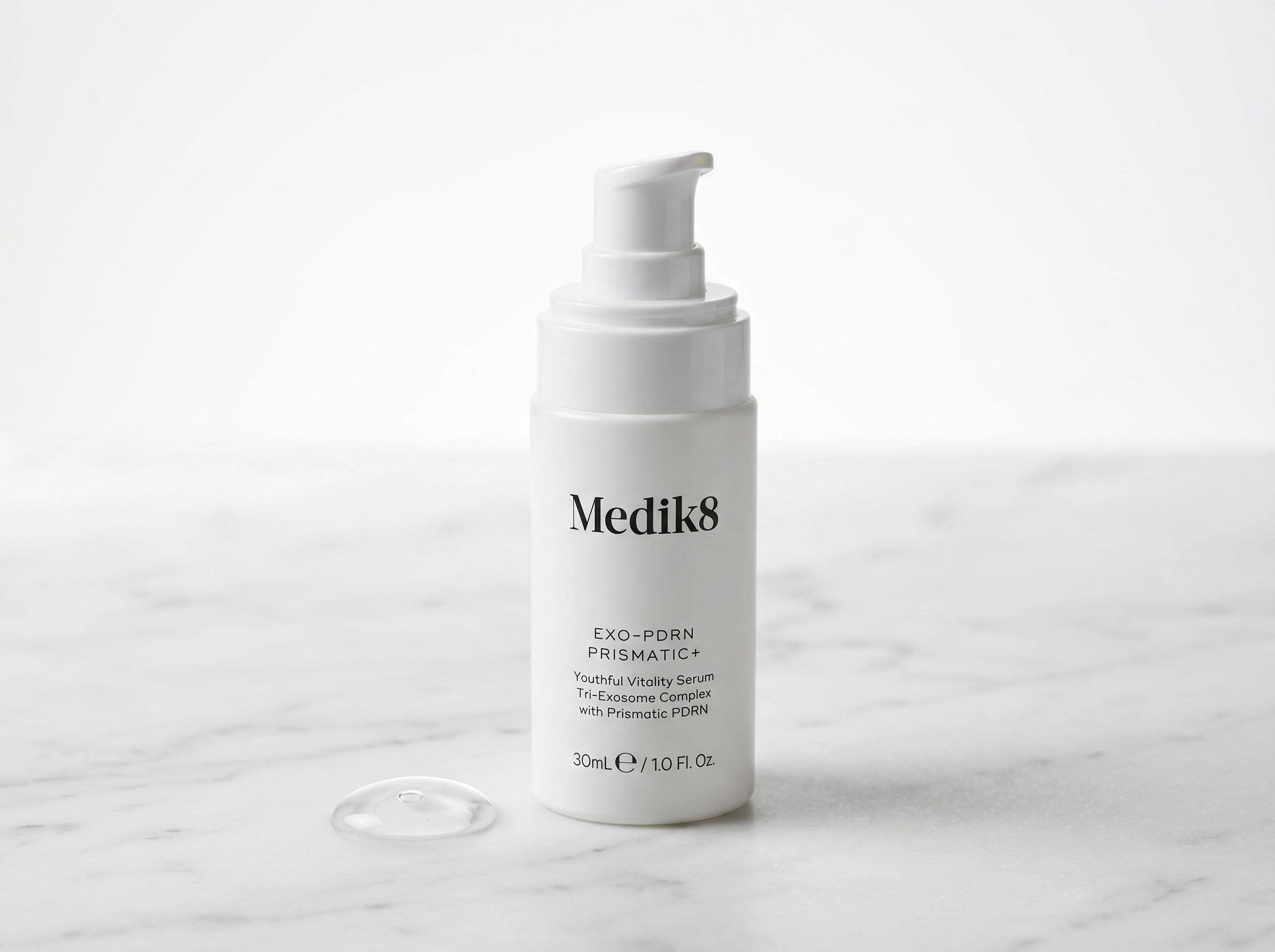
Exo-PDRN Prismatic+ is a full-spectrum face serum built around two key technologies: a Triple Exosome Complex and Prismatic PDRN (Polydeoxyribonucleotide). These work together to target pigmentation at the signal level, while also restoring the cellular energy your skin needs to act on those signals.
Exosomes are tiny messenger particles that carry instructions between cells. In this formulation, the Triple Exosome Complex delivers signals that suppress Endothelin-1 and Stem Cell Factor, the two proteins that activate your melanocytes. Less activation means less excess pigment being produced. Your brightening serum then has a smaller, more manageable problem to address on the surface.
PDRN (Polydeoxyribonucleotide) adds a second layer. It is a DNA-derived molecule that restores ATP, the energy currency your cells use to carry out repair and renewal. Think of it this way: even if your skin receives the right instructions, it needs fuel to act on them. PDRN restores that fuel.
Clinical data shows Exo-PDRN Prismatic+ boosts cell activity by over 50% in ex vivo testing, with visible improvements in skin health, luminosity, and tone within seven days. This is not just signal suppression. It is energy restoration working alongside it.
How Does This Work With a Brightening Serum?
A good brightening serum, whether it contains vitamin C, niacinamide, alpha arbutin, or kojic acid, works at the melanin level. It either blocks the enzyme (tyrosinase) that produces melanin, or it speeds up cell turnover so pigmented cells shed faster. These are downstream actions. They are effective, and they are necessary. But they work best when the upstream signals driving excess pigment production are already under control.

This is where Exo-PDRN Prismatic+ changes the equation. By suppressing Endothelin-1 and Stem Cell Factor before they reach your melanocytes, it reduces how much new pigment your skin is being told to make. Your brightening serum then works on a calmer system. Less new pigment forming means the serum can focus on clearing what is already there, rather than constantly playing catch-up.
The pairing also works at the energy level. Many brightening actives require healthy, well-functioning cells to deliver results. PDRN-driven ATP restoration means your skin cells are better equipped to respond to those actives. If you have ever felt like your brightening serum stopped working, or hit a plateau, cellular energy depletion may be part of the reason. You can read more about how vitamin C supports pigmentation and why pairing it with upstream support makes a real difference.

Featured: Exo-PDRN Prismatic+
A full-spectrum face serum that boosts skin's natural rejuvenation by over 50%.
Shop Now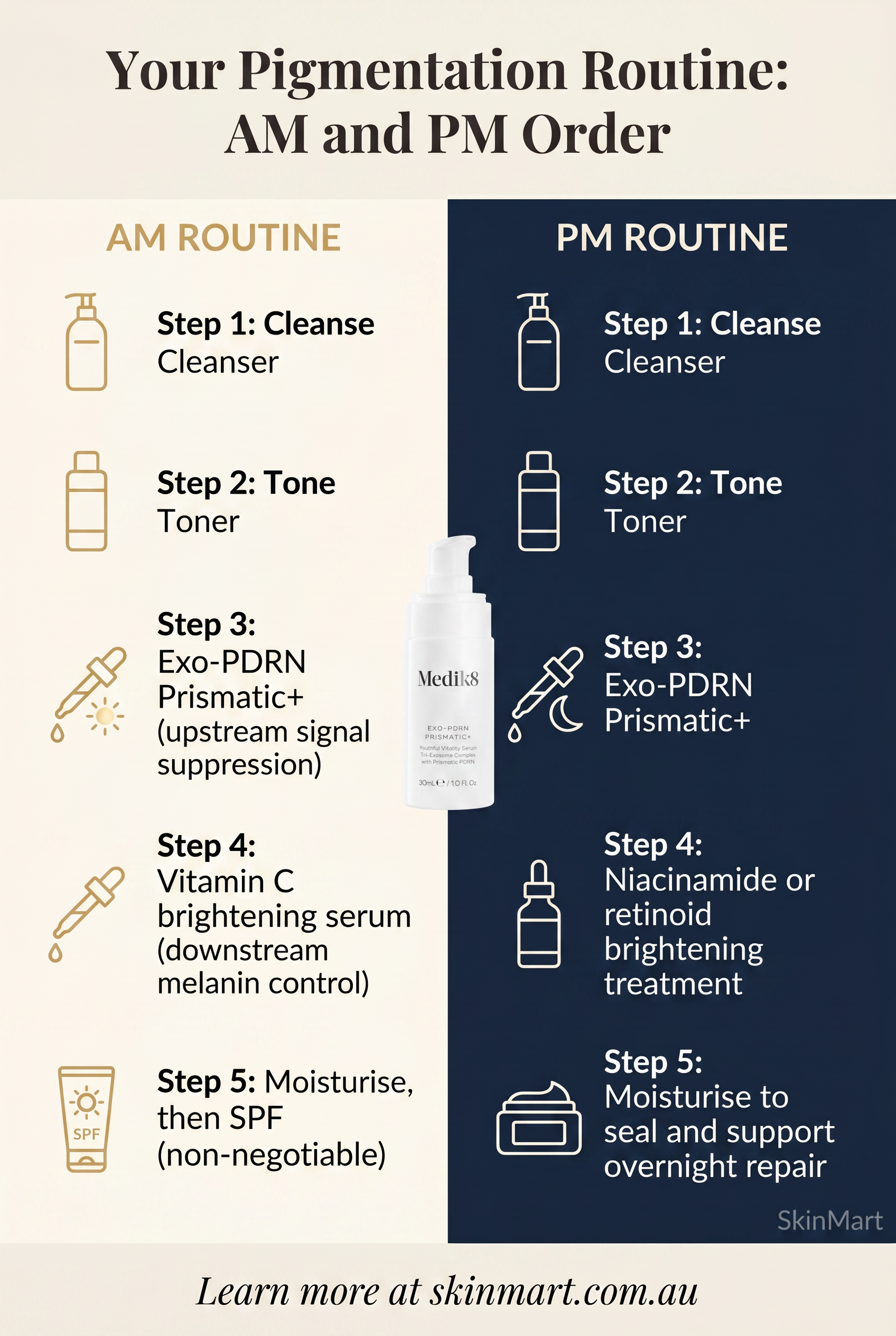
How Do You Add Exo-PDRN Prismatic+ to Your Routine?
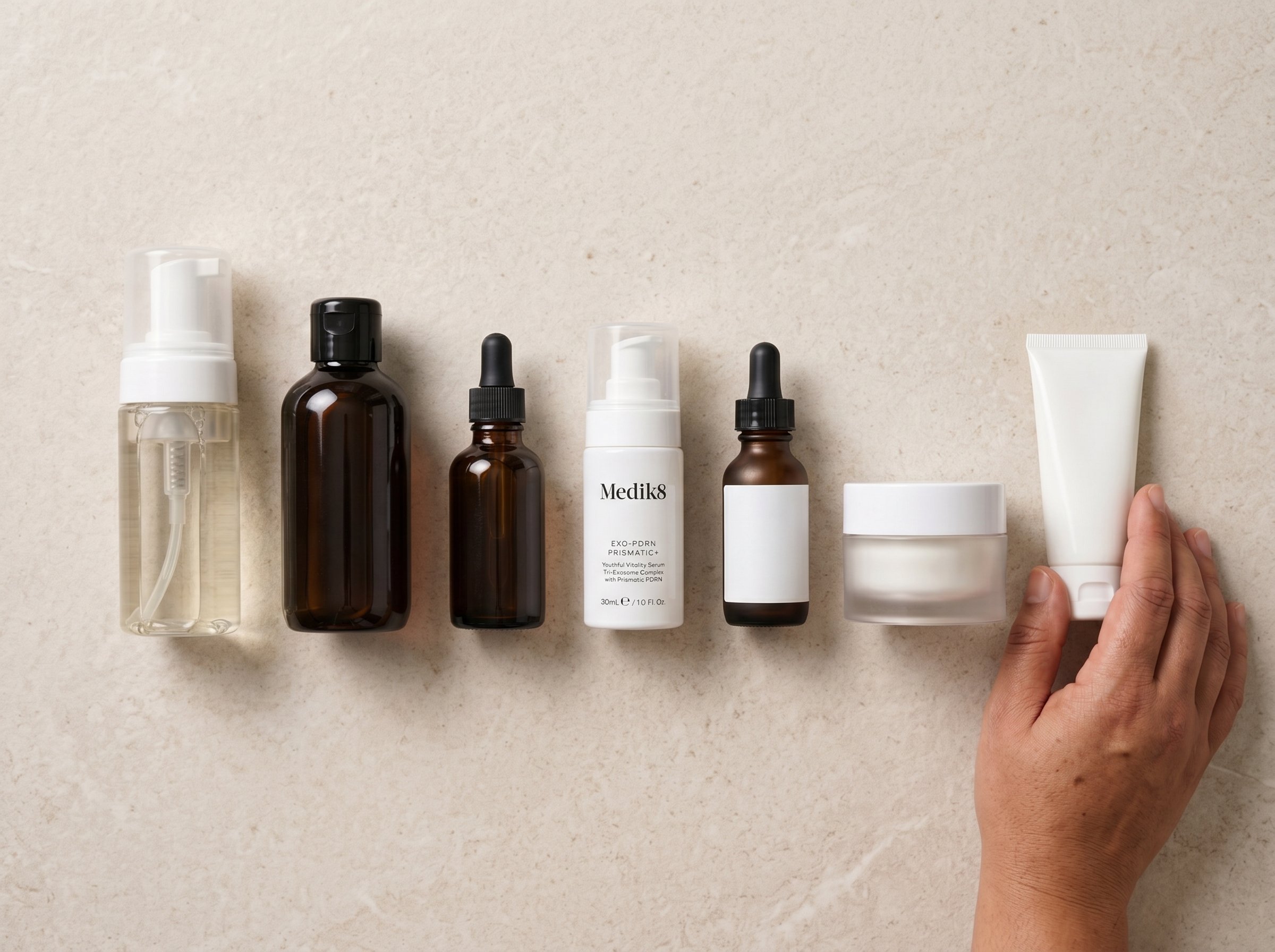
Routine placement matters. Exo-PDRN Prismatic+ is applied after cleansing and toning, before your brightening serum. This order is intentional. You apply the upstream signal suppressor first, then follow with the downstream brightening active. The two work in sequence, not in competition.
In the morning, this might look like: cleanse, tone, Exo-PDRN Prismatic+, vitamin C serum, moisturiser, SPF. At night, you might swap the vitamin C for a retinoid or niacinamide-based treatment. Sun protection remains non-negotiable.
UV exposure is one of the primary triggers for Endothelin-1 release. So without SPF, you are feeding the very signals the product is working to suppress. For more on getting your product order right, our layering guide is worth reading before you start.
Clinical results show improvements in skin health, luminosity, and tone within seven days. Volume and texture improvements build over fourteen days. This is a product for consistent, committed use, not a quick fix. If you are expecting overnight results, this is not the right match. But if you are ready to address pigmentation at the system level and let your brightening serum do more with less resistance, the combination is worth your attention.
Is Exo-PDRN Prismatic+ Right for Your Skin?
This product suits skin experiencing post-inflammatory hyperpigmentation (dark marks left after breakouts or irritation), UV-induced dark spots, or uneven tone that has not fully responded to brightening serums alone. It is also validated for use after skin procedures, with 98% of users in clinical testing agreeing it supported recovery without disruption. If your skin barrier is already severely compromised, or you have a known sensitivity to nucleotides, this is not the right starting point. Check with a skin professional first.
It is also worth being honest about timing. Exo-PDRN Prismatic+ is not a replacement for a brightening serum. It is a complement to one.
If you do not yet have a consistent brightening routine in place, building that foundation first makes sense. If you do have a routine but feel like it has stalled, this is where upstream support becomes relevant. Our analysis suggests the greatest benefit comes when both levels of the pigmentation process are being addressed at the same time.
If you are unsure where your skin sits right now, starting your Skin Blueprint is the clearest path forward. It helps us understand your specific pigmentation pattern, your skin's current tolerance. And what combination of products and lifestyle factors will actually move the needle for you. Not what is trending. What is right for your skin.
Dark spots are not just a surface issue. They start with signals, deep in your skin, that tell your melanocytes to overproduce pigment. Most brightening serums address what happens after those signals fire.
Exo-PDRN Prismatic+ addresses the signals themselves, using a Triple Exosome Complex to suppress Endothelin-1 and Stem Cell Factor. And Prismatic PDRN to restore the cellular energy your skin needs to act on that suppression. Used together, the two approaches cover the full pigmentation process, upstream and downstream, in a way that neither can achieve alone.
If your brightening routine has stalled, or your dark spots keep returning despite consistent care, this is worth exploring. Shop Exo-PDRN Prismatic+ now, or book a skin consultation to get a personalised recommendation built around your specific pigmentation pattern, not just what works for everyone.


