You have been consistent with your retinol. You use it correctly, you give it time, and still something feels like it has stopped working. The texture improvements slowed.
The firmness you expected never quite arrived. If this sounds familiar, the issue may not be your retinol at all. It may be the energy your skin cells have available to act on it.
This post looks at one specific mechanism behind that plateau, and how Exo-PDRN Prismatic+ by Medik8 addresses it. The angle here is energy, not just signals. Understanding the difference changes how you think about ageing skin care.
Why Do Ageing Skin Cells Run Low on Energy?
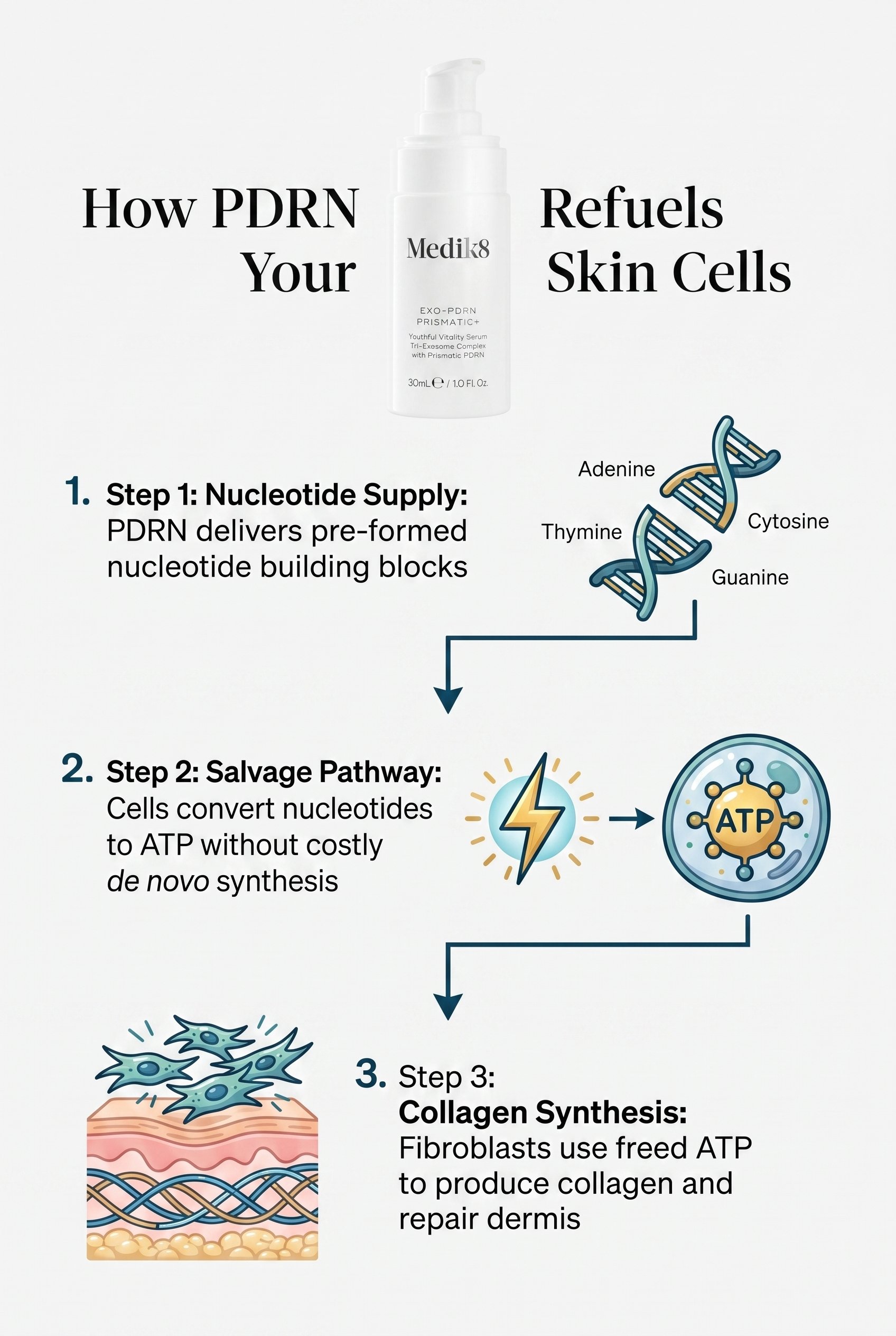
Every function your skin performs requires ATP. ATP (adenosine triphosphate) is the energy currency inside every cell. Fibroblasts, the cells in your dermis that produce collagen and elastin, are especially dependent on it. Without enough ATP, they cannot build structural proteins at the rate your skin needs.
As skin ages, mitochondrial function declines. Mitochondria are the small structures inside cells that generate ATP. Research shows that photoaged skin can produce up to 50% less ATP than protected skin. That is not a minor drop. It means your fibroblasts are working with half the fuel they once had.
At the same time, NAD+ levels, a coenzyme that powers mitochondrial activity, fall by roughly 50% between your 20s and 50s. Senescent cells, those that have stopped dividing but remain active, accumulate in the dermis and release inflammatory signals that further drain cellular resources. The result is a skin environment where the capacity for repair is genuinely reduced, not just slowed.
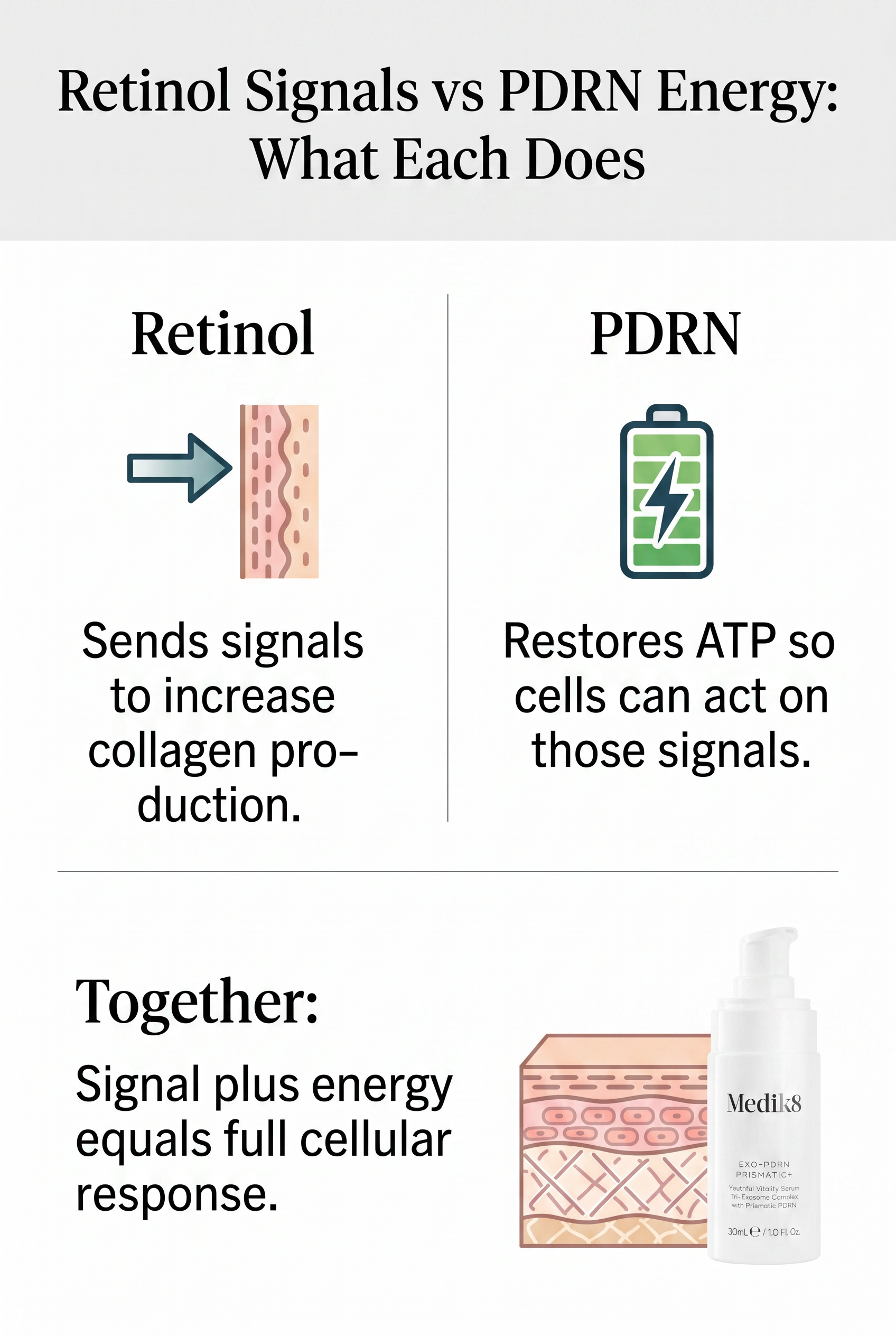
This is why retinol can feel less effective over time. Retinol sends the right signals to your cells. But if those cells lack the ATP to act on those signals, the response is limited. Starting retinol is the right move, but energy restoration may be what makes it work properly.
What Is PDRN and How Does It Restore Cellular Energy?
PDRN stands for Polydeoxyribonucleotide. It is a compound made from short fragments of DNA. In skin care, it is used because it provides nucleotide building blocks, the raw materials cells need to repair DNA and run energy-producing processes.

Here is why that matters. When fibroblasts are stressed or depleted, they spend energy trying to source nucleotide materials from scratch. This is a costly process called the de novo pathway.
PDRN bypasses that. It supplies pre-formed nucleotides that cells can use directly through a more efficient route called the salvage pathway. The result is less energy spent on sourcing materials and more energy available for actual repair and collagen synthesis.
PDRN also activates adenosine A2A receptors on cell surfaces. These receptors are linked to tissue repair, reduced inflammation, and improved cellular metabolism. Clinical research on PDRN in wound healing and tissue regeneration shows consistent support for these mechanisms. In skin, this translates to a more energised cellular environment, one that is better equipped to respond to active ingredients.
Exo-PDRN Prismatic+ uses what Medik8 calls Prismatic PDRN, a specific form of PDRN designed for topical delivery. Our analysis of the formulation suggests this is a meaningful distinction. Delivery matters as much as the ingredient itself.
Key Takeaways
- Exo-PDRN Prismatic+ recharges ageing skin by restoring ATP, the energy currency fibroblasts need to produce collagen.
- PDRN (Polydeoxyribonucleotide) supplies nucleotide building blocks that fuel cellular repair.
- A Triple Exosome Complex delivers growth signals that guide how that energy is used.
- Together, they help skin cells work more efficiently, which may improve how well active ingredients like retinol perform.
- Clinical data shows improvements in skin health, luminosity, and barrier funct...
What Role Do Exosomes Play Alongside PDRN?
Exosomes are tiny vesicles, small membrane-bound particles, that cells use to communicate. They carry proteins, lipids, and genetic material called miRNA (microRNA) between cells. Think of them as message packets. They do not supply energy directly. Instead, they tell cells how to use the energy they have.
Exo-PDRN Prismatic+ contains a Triple Exosome Complex. This combines exosomes from three different sources, each targeting a different aspect of skin function. Where PDRN restores the fuel supply, exosomes direct how that fuel is allocated. Together, they address both the capacity and the coordination of cellular repair.
This pairing is what makes the Energy, Not Just Signals angle meaningful. Many regenerative products focus on signalling alone. Signals tell cells what to do. But if the cell lacks the ATP to follow through, the signal goes unanswered. By pairing exosome signalling with PDRN-driven energy restoration, Exo-PDRN Prismatic+ works on both sides of that equation.
Ex vivo data (testing on human skin tissue outside the body) shows a greater than 50% boost in cell proliferation with this combination. Cell proliferation, the process of new cells forming and dividing, is directly linked to collagen renewal and barrier repair. That is a meaningful result for ageing skin.
What Does the Clinical Data Actually Show?
Clinical data for Exo-PDRN Prismatic+ covers two time points. At seven days, participants showed improvements across skin health, luminosity, tone, and barrier function. At fourteen days, improvements in skin volume and wrinkle appearance were recorded. These are not dramatic transformation claims. They are incremental, measurable changes that align with what cellular energy restoration would produce.
The post-procedure data is also worth noting. 98% of participants agreed the product was effective after professional skin treatments. This matters because post-procedure skin is in a vulnerable state. Barrier function is temporarily compromised. The fact that this product performed well in that context supports the idea that it is genuinely supporting cellular repair, not just sitting on the surface.
For ageing skin specifically, the seven-day barrier improvement is significant. A stronger barrier retains more moisture and reduces the inflammatory load on skin cells. Less inflammation means more cellular energy directed toward repair rather than defence. This is a compounding benefit, not a single isolated effect.
If you are curious about how DNA-level technology supports skin repair more broadly, our article on DNA technology in skin care gives useful context for understanding why nucleotide-based ingredients are gaining clinical attention.

Featured: Exo-PDRN Prismatic+
A full-spectrum face serum that boosts skin's natural rejuvenation by over 50%.
Shop NowHow Does Exo-PDRN Prismatic+ Fit Into an Ageing Skin Routine?
Exo-PDRN Prismatic+ is a serum. It sits in your routine after cleansing and before heavier moisturisers. It is designed to work alongside your existing actives, not replace them. If you are using retinol, this product is not a substitute. It is a support layer that may help your retinol work more effectively by improving the cellular environment it acts on.
The product is validated for post-procedure use, which means it is formulated to be gentle enough for compromised skin. For those who use professional treatments like laser, microneedling, or peels, it may fit naturally into the recovery phase of their routine. That said, always confirm post-procedure product use with your treating therapist.
For everyday ageing skin care, the routine logic is straightforward. You clean, you apply your energy-restoring serum, you apply your active (retinol or similar), and you seal with SPF in the morning. The serum step is where Exo-PDRN Prismatic+ sits. It prepares the cellular environment rather than competing with other steps.
Understanding product layering is something many people find confusing. Our guide on using products in the right order is a useful reference if you want to make sure your routine is structured correctly.
Is This Product Right for Your Skin?
Exo-PDRN Prismatic+ is best suited to skin that is in a stable, non-acute state. It is designed for ageing skin concerns including loss of firmness, reduced luminosity, and declining barrier function. It is also suited to skin recovering from professional treatments, provided the barrier is not severely compromised.

This product is not positioned for active acne, severe barrier disruption, or those with known nucleotide sensitivities. It is also not a replacement for retinol or other proven actives. If you are looking for a single product to address everything, this is not that. It is a targeted addition to a well-structured routine.
The question worth asking is not whether this product works in general. The question is whether your skin, at this point in time, would benefit from energy restoration at the cellular level. If your actives have plateaued, if your skin feels less responsive than it used to, or if you are looking to support a post-treatment recovery, the mechanism here is relevant to your situation.
If you are still building your understanding of how active ingredients work together, our article on active ingredients is a good starting point before adding new layers to your routine.
The reason ageing skin stops responding the way it used to is often not about the products you are using. It is about the cellular environment those products are working in. When fibroblasts are low on ATP, when mitochondrial function has declined. And when the salvage pathways that support cellular repair are underused, even well-chosen actives have less to work with.
Exo-PDRN Prismatic+ addresses that gap directly. By combining Prismatic PDRN with a Triple Exosome Complex, it works on both the energy supply and the signalling that directs how that energy is used. The clinical data supports meaningful improvements within seven to fourteen days. For ageing skin that has plateaued, that is a mechanism worth understanding. Shop now to add Exo-PDRN Prismatic+ to your routine, or book your skin Consultation to find out whether this is the right next step for your skin specifically.


