
You've used the serums. You've been consistent. You've watched the spots fade, felt hopeful, and then watched them come back.
If that cycle sounds familiar, you're not doing anything wrong. The issue is that most pigmentation treatments are built around the same idea: reduce the melanin you can see. That's a reasonable place to start, but it's not the whole picture.
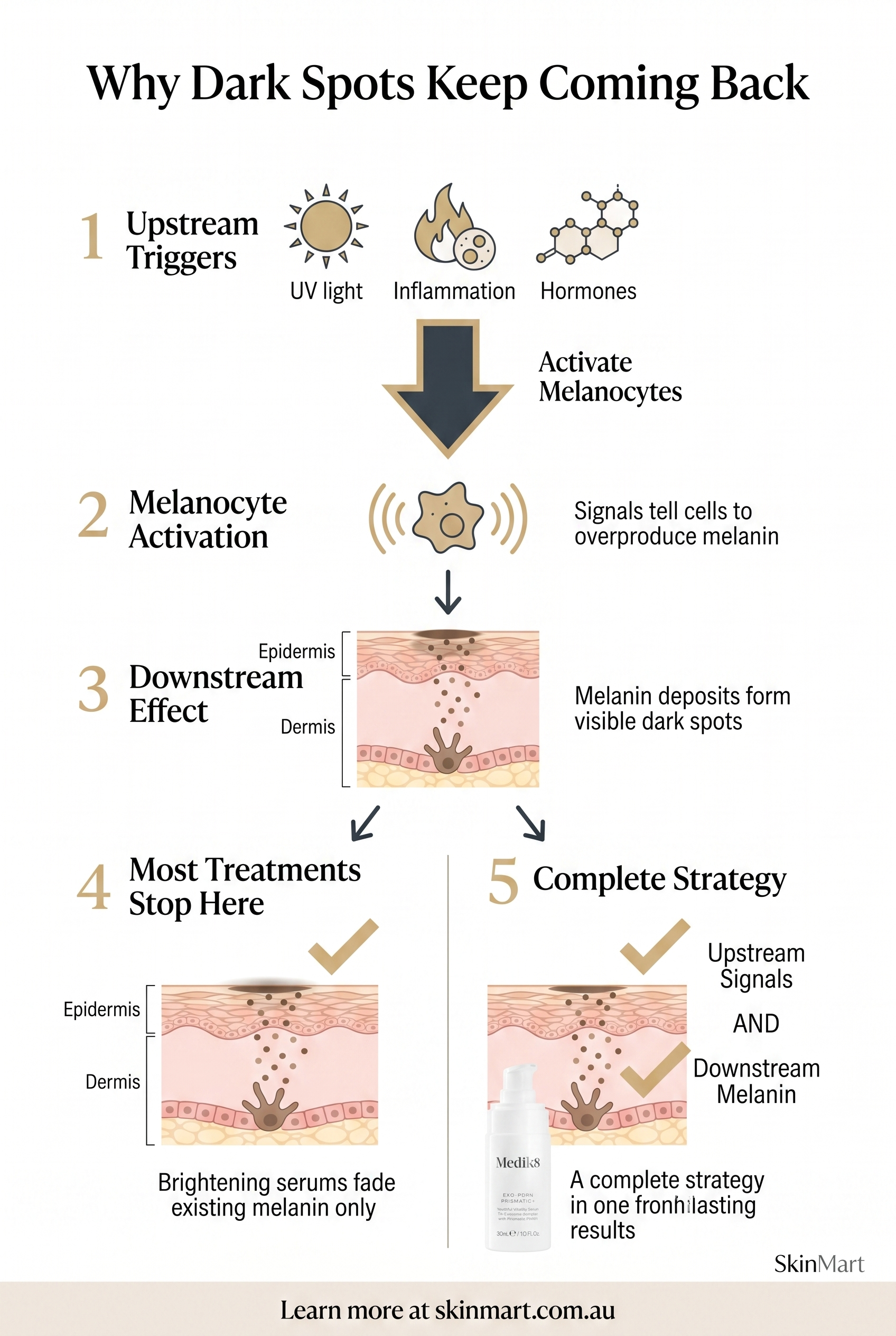
Dark spots keep coming back because something upstream is still sending the signal to make more. Your skin's pigment-producing cells, called melanocytes, don't overproduce on their own. They respond to triggers.
And if those triggers are still active, no brightening serum in the world will give you lasting results. This post looks at what those upstream signals actually are, why they matter more than most people realise. And what a more complete approach to pigmentation looks like.
What Are Melanocytes Actually Responding To?
Melanocytes are the cells in your skin that produce melanin, the pigment that gives skin its colour. They sit in the deeper layers of your outer skin (the epidermis) and they don't produce melanin randomly. They produce it in response to signals. UV exposure is the most well-known trigger, but it's far from the only one.
Inflammation is a major driver. Every time your skin experiences irritation, a breakout, or barrier disruption, your body releases inflammatory messengers. Some of those messengers, including a protein called endothelin-1 and a growth factor called stem cell factor (SCF), directly activate melanocytes.
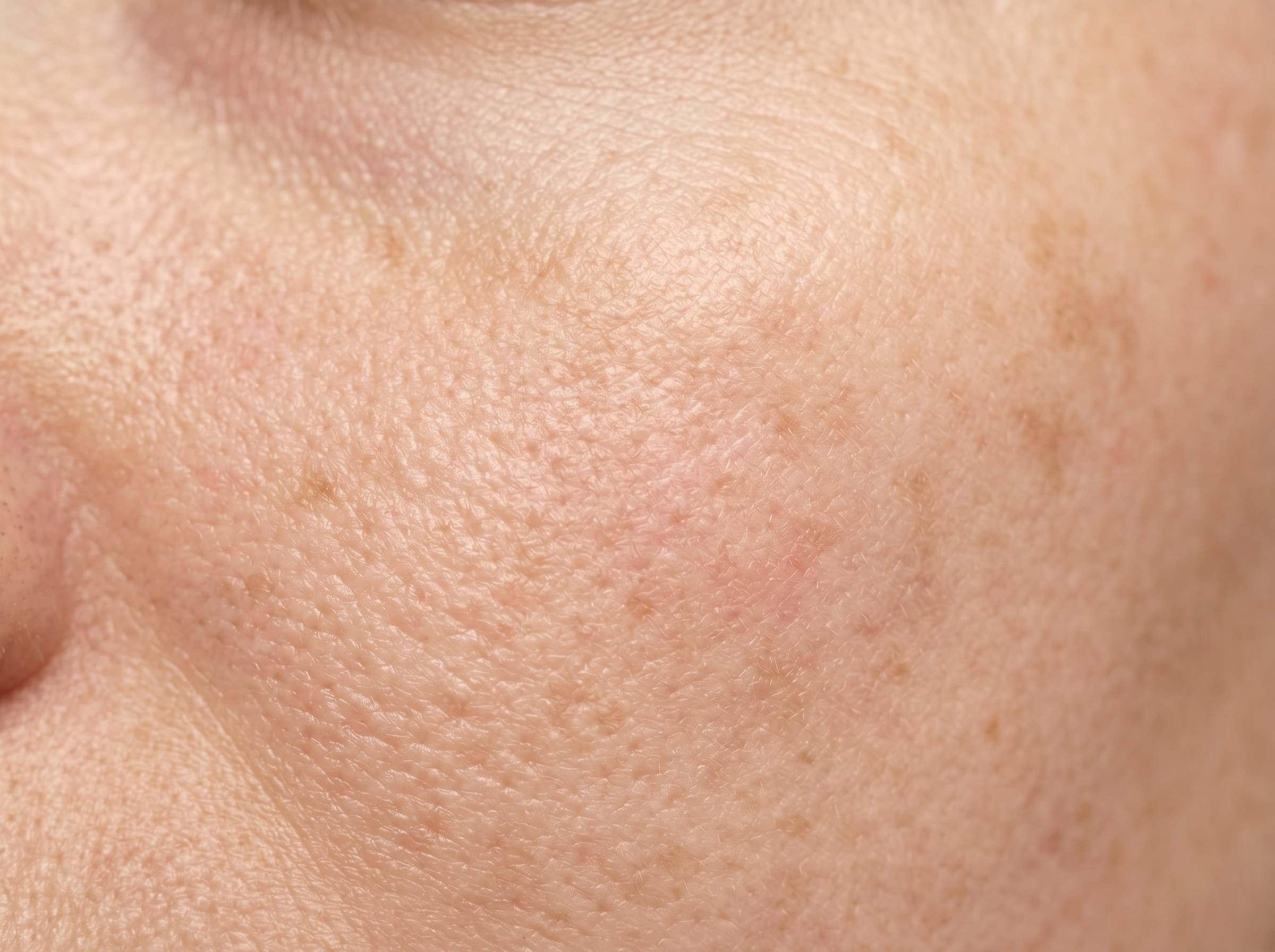
This is why a pimple that heals in a week can leave a dark mark that lasts for months. The spot isn't the problem. It's the signal the inflammation sent.
Hormonal changes add another layer. Oestrogen and progesterone fluctuations can push melanocyte activity higher, which is why pigmentation often worsens around perimenopause or after hormonal shifts. Sun exposure then acts like fuel on an already active fire. You can read more about how pigmentation forms and how to treat it in our guide on pigmentation and how we can treat it.
Why Downstream Treatments Only Get You Halfway
Downstream treatments work on melanin that has already formed. Vitamin C, kojic acid, arbutin, and alpha hydroxy acids (AHAs, which are exfoliating acids) are all examples. They are genuinely useful. They help fade existing spots and improve overall skin tone. But they don't stop the signals that created those spots in the first place.
Think of it this way. If a tap is overflowing, mopping the floor is useful. But unless you turn down the tap, you'll be mopping forever.
Downstream brightening is the mop. Upstream signal regulation is the tap. Most routines only include the mop.
This is also why pigmentation responds so differently from person to person. Two people can use the same vitamin C serum with very different results. If one person's upstream triggers are mostly managed (good sun protection, low inflammation, stable hormones), the serum works well. If the other person's triggers are still active, the serum fades spots that keep reforming.
The serum isn't failing. The strategy is incomplete. Our article on skin brightening ingredients covers the downstream side of this in more detail.
Key Takeaways
- Dark spots return because most treatments target melanin after it forms, not the signals that tell your skin to overproduce it.
- Upstream triggers like inflammation, UV exposure, and hormonal changes activate melanocytes (your pigment-producing cells) repeatedly.
- Without addressing those signals, new pigmentation keeps forming even as existing spots fade.
- Lasting results require both downstream brightening and upstream signal regulation, supported by skin energy and barrier health.
The Energy Problem Nobody Talks About
There's a third layer to this that rarely gets discussed: cellular energy. Your skin cells need energy to carry out repair, regulate inflammation, and respond proportionally to signals. That energy comes from ATP (adenosine triphosphate), which is produced inside your cells.
When skin is chronically stressed, sun-damaged, or ageing, ATP production slows down. Cells lose their ability to regulate their own responses effectively. Melanocytes that should calm down after a trigger stay active longer. Repair processes that should clear inflammation stall. The result is a skin environment where pigmentation signals run longer and stronger than they should.
This is where newer regenerative ingredients are changing the conversation. PDRN (polydeoxyribonucleotide) is a DNA-derived ingredient that supports the skin's own repair pathways and has been shown to boost cellular energy. When cells have more energy available, they regulate more effectively. They respond to signals, then return to baseline, rather than staying in an overactive state. This matters enormously for pigmentation, because it addresses a root cause that brightening serums simply can't reach.
What a More Complete Pigmentation Strategy Looks Like
A complete approach to pigmentation works at three levels at the same time. First, you protect against triggers. Broad-spectrum SPF is non-negotiable here. UV exposure is the most consistent activator of melanocyte signalling, and no brightening ingredient can outwork daily unprotected sun exposure. Iron oxide tints in your SPF add extra protection against visible light, which also triggers melanin production, especially in hormonal pigmentation like melasma.
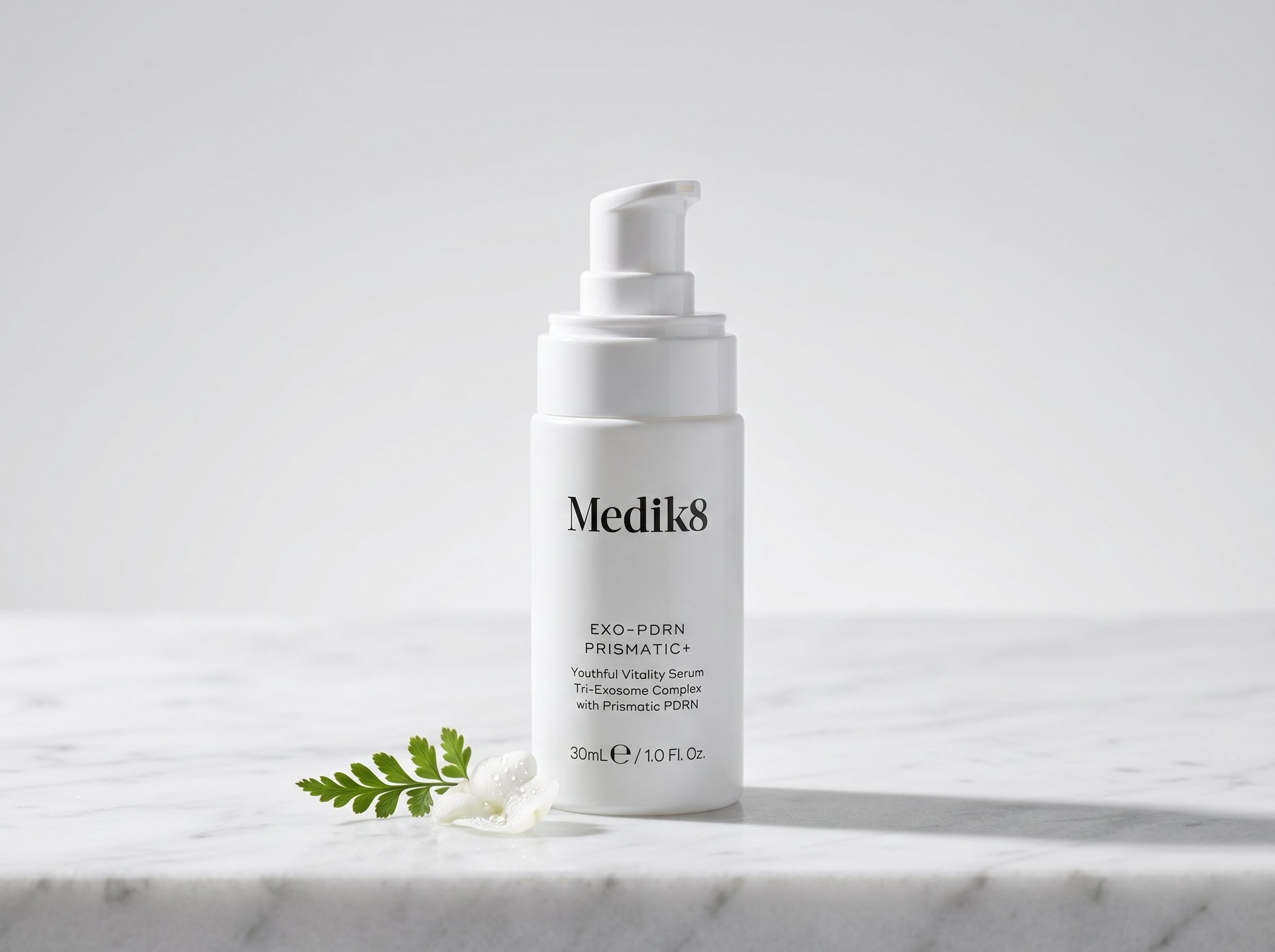
Second, you manage inflammation actively. Niacinamide (a form of vitamin B3) is one of the best-studied ingredients for this. It reduces the transfer of melanin to skin cells and calms the inflammatory signals that trigger overproduction. Azelaic acid does similar work.
These aren't just brightening agents. They're signal regulators. For more on how active ingredients fit into your routine, our guide on active ingredients is a good starting point.
Third, you support cellular repair and energy. This is where regenerative technology like exosomes and PDRN come in. Exosomes are tiny messenger vesicles that carry instructions between cells. They help coordinate repair, reduce inflammatory signalling, and support the skin's ability to return to a balanced state. Combined with PDRN's ATP-supporting action, this approach addresses the energy and signalling environment that determines how your skin responds to triggers over time.

Featured: Exo-PDRN Prismatic+
A full-spectrum face serum that boosts skin's natural rejuvenation by over 50%.
Shop Now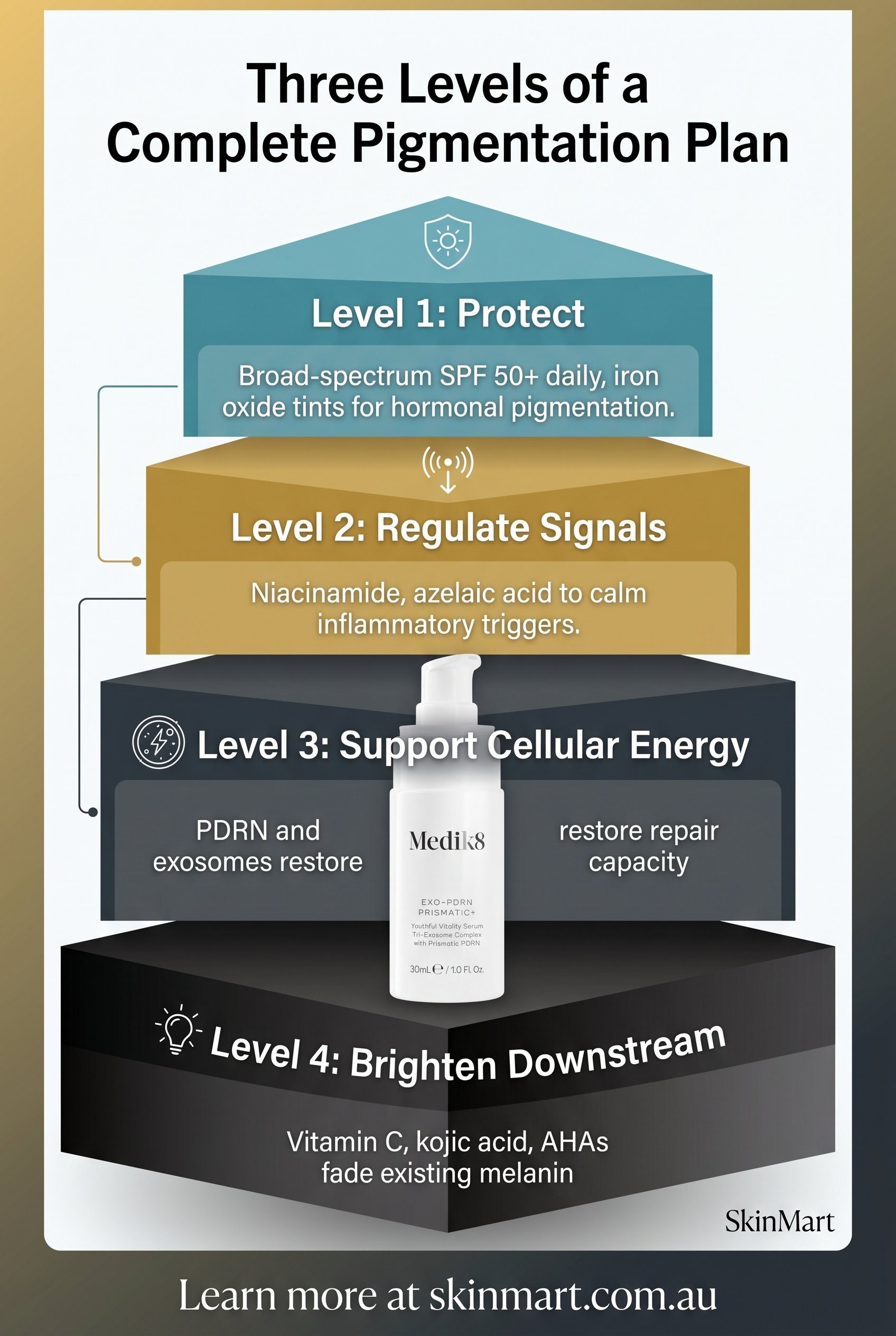
How Exo-PDRN Prismatic+ Fits Into This Approach
Exo-PDRN Prismatic+ by Medik8 is built around this upstream logic. It combines a Triple Exosome Complex with Prismatic PDRN to work on the signalling and energy environment of your skin, not just the melanin you can see. In clinical testing, it showed improvements in skin health, luminosity, and tone within seven days. Cell proliferation (the rate at which new skin cells are produced) increased by over 50% in ex vivo testing.
This isn't a replacement for your brightening serum. It works alongside it. While your vitamin C or niacinamide handles downstream melanin reduction, Exo-PDRN Prismatic+ works upstream, supporting the cellular environment that determines how often and how strongly your melanocytes respond to signals. The two approaches together are more effective than either alone.
It's also been validated for use after skin procedures, with 98% agreement on efficacy in post-procedure skin. This matters for pigmentation because many in-clinic treatments create temporary inflammation that can worsen pigmentation if the skin's repair response isn't well supported. Shop Exo-PDRN Prismatic+ now to see where it fits in your routine.
What This Means for Your Routine Right Now
You don't need to overhaul everything. Start by asking one question: is your current routine only working downstream? If your answer is yes (brightening serums, exfoliating acids, spot treatments), that's a strong foundation. But it's only half the strategy.

Add upstream support by locking in daily SPF, including an anti-inflammatory ingredient like niacinamide if you don't already use one. And considering a regenerative serum that supports cellular energy and signalling. Consistency matters more than complexity. A simple routine done every day will outperform an elaborate one done occasionally.
Pigmentation takes time. Your skin's renewal cycle is roughly 28 days, which means changes at the cellular level take weeks to become visible. Most people see initial improvements in brightness within four to six weeks of a complete strategy.
Significant spot fading typically becomes visible at eight to twelve weeks. The goal isn't fast results. It's results that actually last, because you've addressed what was causing the problem, not just what the problem looked like.
Dark spots coming back isn't a sign that your products aren't working. It's a sign that the strategy needs to go further upstream. When you only treat melanin after it forms, you're managing a symptom. When you also address the signals that create it, you're working on the cause. That's the difference between results that fade and results that last.
If you're ready to look at your pigmentation routine with fresh eyes, starting with a personalised skin consultation is the most useful first step. It helps you understand what your specific triggers are, which upstream and downstream strategies will work best for your skin. And where something like Exo-PDRN Prismatic+ fits into the bigger picture. Shop Exo-PDRN Prismatic+ now or book your skin consultation to start building a plan that's built around your skin, not around what's trending.


