
You've cut out fragrance. You've switched to gentle cleansers. You've read every ingredient list. And your skin is still reacting to things it shouldn't.
If that sounds familiar, you're not doing anything wrong. The problem isn't the products you're choosing. The problem is what's happening underneath.
Reactive skin has a root cause that most advice never addresses. It's not a long list of bad ingredients. It's a broken system, a compromised skin barrier and an inflammatory response that's stuck in the "on" position. Once you understand that, everything changes. Not just what you avoid, but what you actually do to get better.
What Is Actually Happening When Your Skin Reacts?
Your skin has a protective outer layer called the stratum corneum. Think of it as a brick wall. The "bricks" are your skin cells.
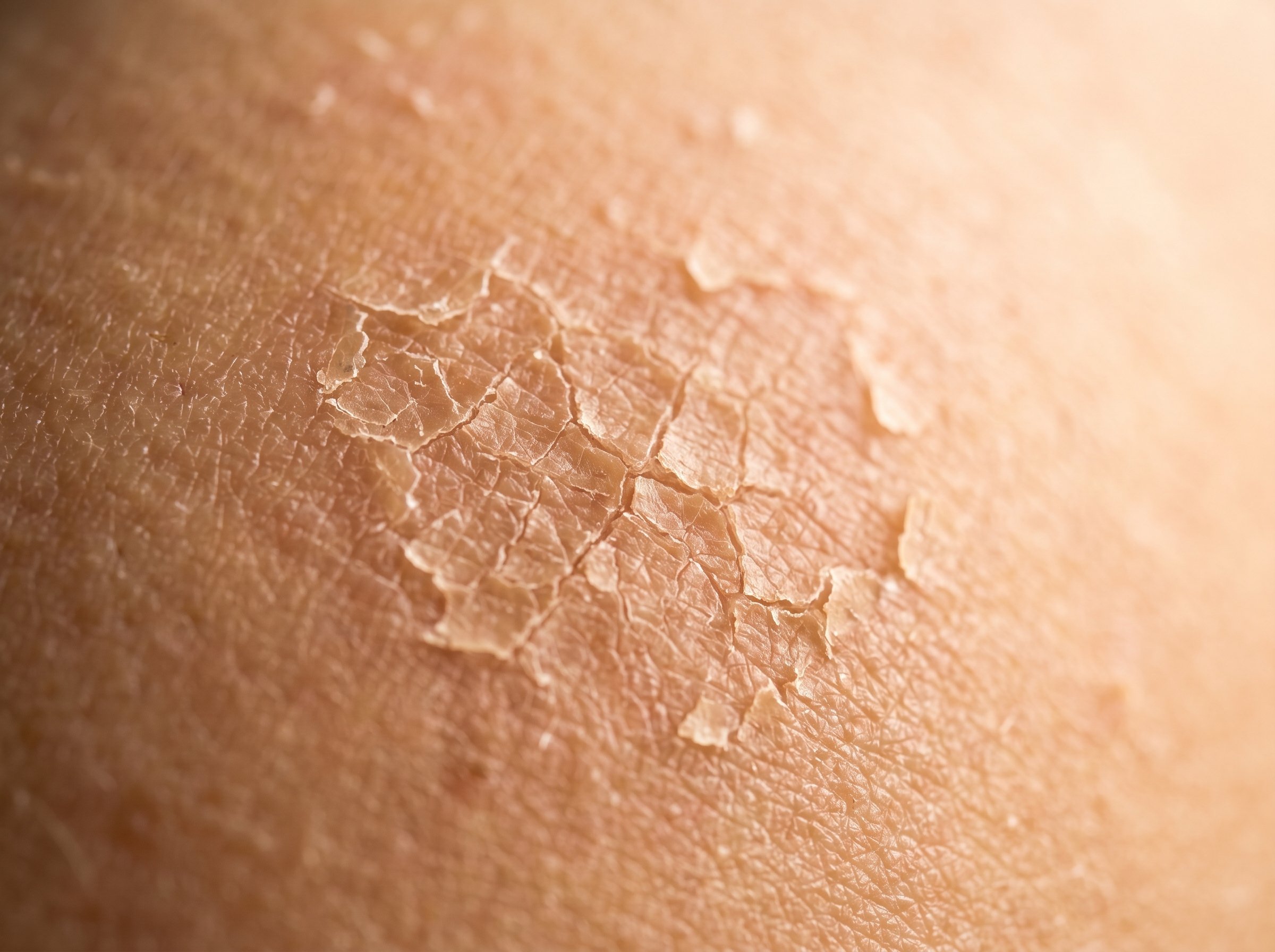
The "mortar" between them is made up of ceramides (natural fats that lock moisture in and keep irritants out). When that mortar breaks down, the wall develops gaps. Irritants, allergens, and bacteria slip through more easily than they should.
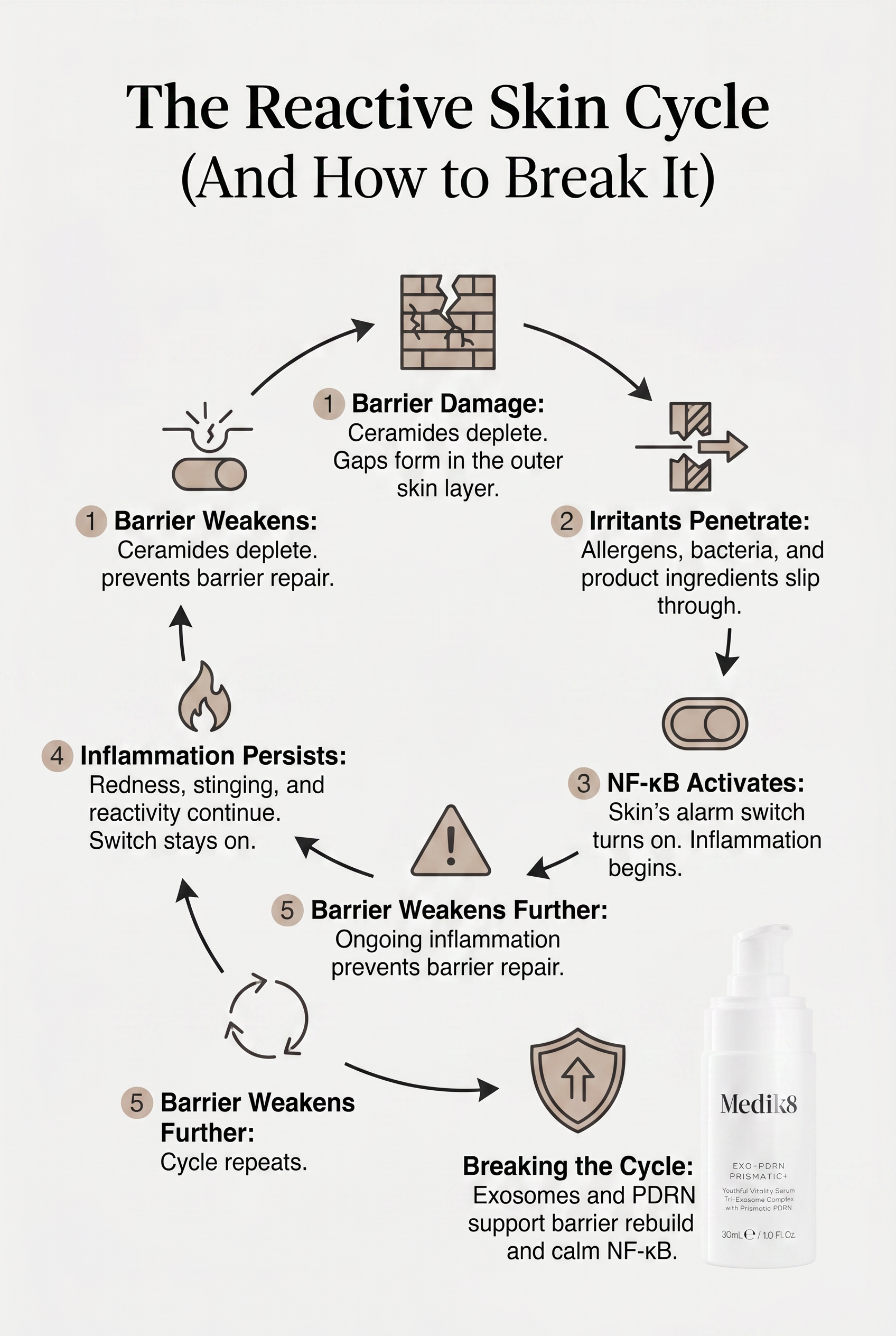
Here's where it gets important. When your barrier is compromised like this, your skin's immune system goes on high alert. It starts reacting to things it would normally ignore, a preservative, a fragrance, even water temperature. This isn't your skin being dramatic. It's your skin doing exactly what it's designed to do when it detects a threat.
The trouble is, once the barrier is damaged, almost everything feels like a threat. So the reactions keep coming, even when you're being careful. Stress can make this worse too, pushing your skin's defences even further out of balance.
Key Takeaways
- Reactive skin is usually caused by two things working together: a damaged skin barrier and an overactive inflammatory response driven by a protein called NF-κB.
- When your barrier is compromised, irritants get in too easily.
- NF-κB then triggers inflammation that doesn't switch off properly.
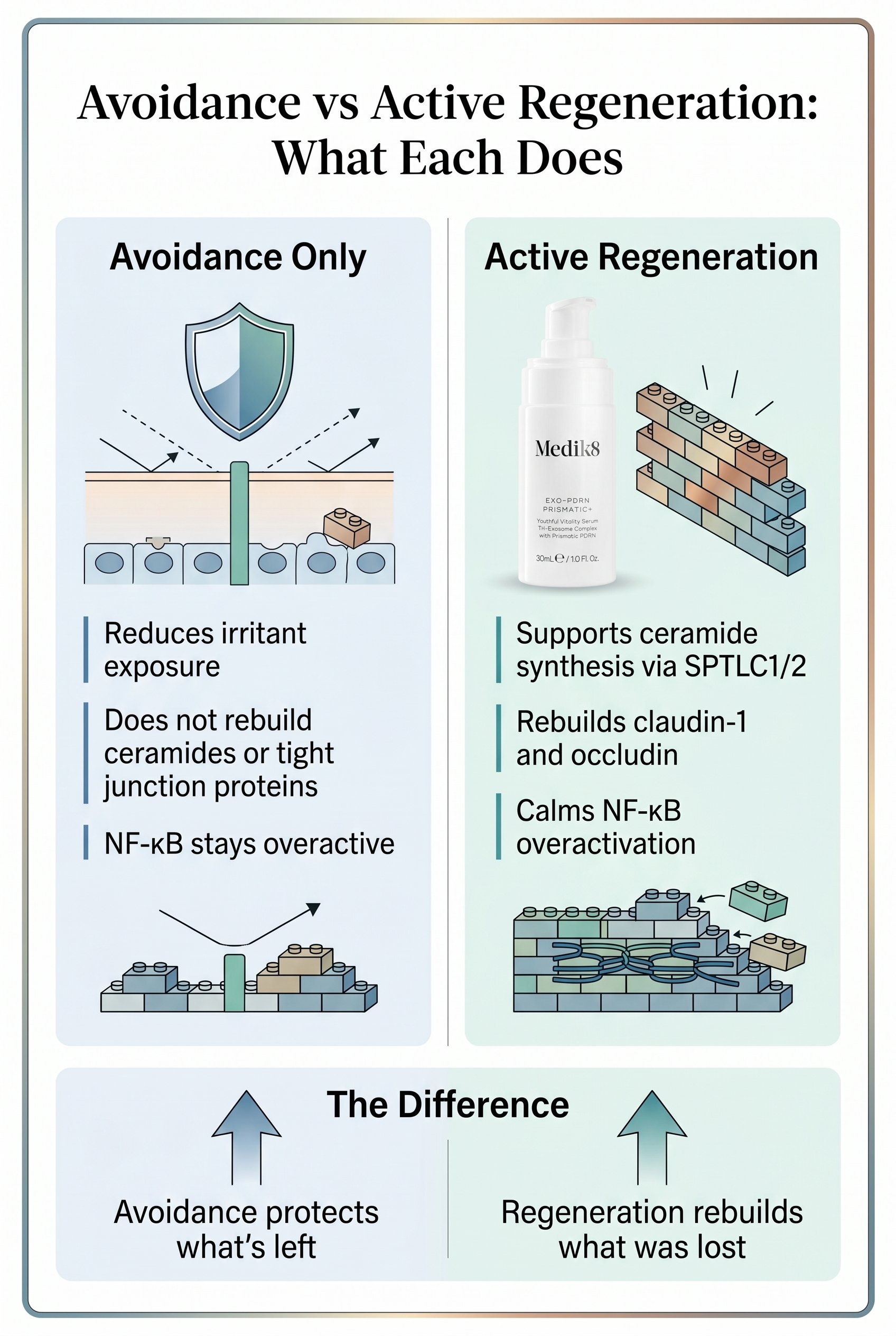
- Avoiding irritants helps, but it doesn't fix the underlying damage.
- Active barrier regeneration, teaching your skin to rebuild its own protective proteins, is what actually breaks the cycle.
What Is NF-κB and Why Does It Keep Your Skin Inflamed?
Inside your skin cells, there's a protein called NF-κB (Nuclear Factor kappa B). It acts like an alarm switch for inflammation. When your skin senses danger, NF-κB activates and triggers an inflammatory response. That's normal and useful. The problem starts when the switch won't turn off.

In reactive skin, NF-κB gets stuck in the "on" position. Researchers call this overactivation. It means your skin is producing inflammatory signals constantly, even when there's no real threat. The result is redness, stinging, swelling, and a barrier that never fully recovers. Each new product or environmental change triggers another round of inflammation before the last one has settled.
This is why avoidance alone doesn't solve reactive skin. You can remove every known irritant from your routine. But if NF-κB is still overactive, your skin will keep reacting. The system itself needs to calm down, not just the triggers around it. Understanding how active ingredients work is a useful starting point for knowing what can actually help.
Why Avoidance Alone Keeps You Stuck
Irritant avoidance is a smart first step. Removing known triggers gives your skin breathing room. But it's a defensive strategy, not a healing one. It reduces the load on a damaged system. It doesn't rebuild the system itself.
Think of it this way. If your roof has a hole in it, you can move your furniture away from the leak. That protects your furniture.
But the hole is still there. Every time it rains, you're back to moving furniture. The only real fix is repairing the roof.
Your skin barrier works the same way. To stop reacting, your skin needs to rebuild the proteins that hold the barrier together. These include ceramides and tight junction proteins called claudin-1 and occludin.
These proteins control what gets in and what stays out. When they're depleted, no amount of careful product selection fully compensates. Your skin needs to start producing them again on its own.
This is also why over-exfoliation is so damaging for reactive skin. It strips away what little barrier function remains, making the cycle harder to break.

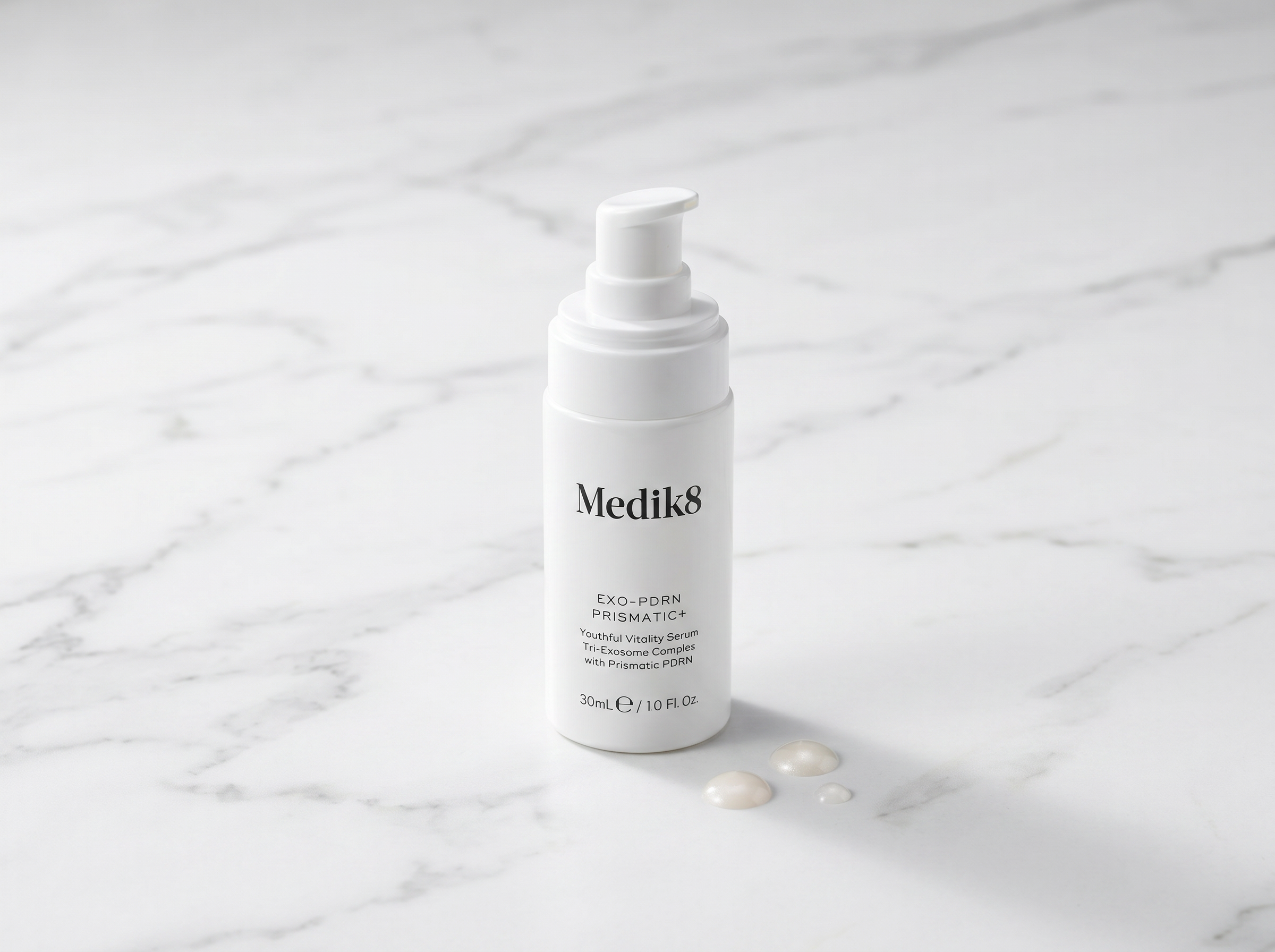
Featured: Exo-PDRN Prismatic+
A full-spectrum face serum that boosts skin's natural rejuvenation by over 50%.
Shop NowWhat Active Regeneration Actually Means for Reactive Skin
Active regeneration means giving your skin the tools it needs to rebuild itself, not just calm the surface. This is different from soothing. Soothing reduces the feeling of irritation temporarily. Regeneration addresses why the irritation keeps happening.
Two ingredients are showing strong results in this area: exosomes and PDRN (Polydeoxyribonucleotide, pronounced poly-dee-oxy-rye-bo-new-klee-oh-tide). Exosomes are tiny messengers released by cells. They carry signals that tell surrounding cells how to behave. In skin, they can signal barrier repair, reduce inflammatory activity, and support the production of structural proteins. PDRN is a DNA-derived ingredient that supports cell repair and has been shown to promote the production of proteins your skin needs to rebuild its barrier.
Together, these ingredients work at the level where reactive skin actually starts. They don't just mask the reaction. They work to address the barrier damage and inflammatory overactivation driving it.
How to Know If This Is What Your Skin Needs
Not every reactive skin situation has the same cause. Some people react to specific allergens. Some have a genetic barrier weakness. Some have developed sensitivity after overusing active ingredients or going through a skin procedure. The common thread is usually some degree of barrier compromise combined with an inflammatory response that's hard to switch off.
Signs that barrier damage and NF-κB overactivation may be driving your reactions include: skin that stings even with gentle products, redness that doesn't fully resolve between reactions, sensitivity that has gotten worse over time rather than better. And reactions to products you previously tolerated fine. Dehydration and barrier damage often overlap, so persistent dryness alongside sensitivity is another signal worth paying attention to.
If this pattern sounds like yours, the answer isn't a longer avoid list. It's a different approach entirely. One that focuses on rebuilding what's been lost, not just protecting what's left.
Reactive skin isn't a personality trait. It's a signal. Your skin is telling you that its barrier is compromised and its inflammatory response has lost its off switch.
Avoidance helps manage the symptoms. But it doesn't fix the underlying problem. Real improvement comes from active regeneration, giving your skin the tools to rebuild what's been damaged.
If you're ready to move past the avoid-everything approach and find out what your skin actually needs, book in for your skin consultation. We'll look at what's driving your reactivity and recommend the right combination of ingredients, products, and routine changes for your skin specifically. Not for every reactive skin type. For yours.
Shop Exo-PDRN Prismatic+ now and take the first step toward skin that reacts less because it's stronger, not just because it's been stripped of everything.


