

You have likely heard the phrase "beauty sleep" your whole life. But it is not just a saying. While you sleep, your skin runs one of its most active repair cycles of the day. Cell renewal speeds up.
Stress hormones drop. Growth hormones rise. Your skin literally rebuilds itself while you rest.
This article looks at the real biology behind what happens to your skin at night. We will cover the repair phases your skin moves through, why your skin absorbs products better after dark. And how to build a simple evening routine that works with your body's natural clock. No fluff, just the science that actually matters for your skin.
What Is Your Skin Actually Doing While You Sleep?
Your skin follows a 24-hour internal clock called the circadian rhythm. Think of it as a built-in schedule that tells your skin when to protect and when to repair. During the day, your skin focuses on defence.

It fights UV rays, pollution, and stress. At night, it switches gears entirely. The repair shift begins.
Cell turnover (the process where old skin cells shed and fresh ones rise to the surface) speeds up greatly during sleep. Research published in the Journal of Investigative Dermatology found that skin cell division peaks between 11 PM and 4 AM. This is your skin's most productive window. Learn more about how your circadian rhythm shapes your skin's daily behaviour.
During this same window, your skin works to repair DNA damage caused by UV exposure during the day. Enzymes called photolyases and nucleotide excision repair proteins get to work fixing strand breaks in your skin cells. Think of it like a night crew coming in to patch up the damage left by the day shift.
Blood flow to the skin also increases while you sleep. This brings more oxygen and nutrients to skin cells. The result is faster healing, better collagen production, and a more even skin tone over time.
Key Takeaways
- During sleep, your skin shifts into active repair mode.
- Cortisol (your stress hormone) drops while human growth hormone rises.
- This triggers cell renewal, DNA repair, and collagen production.
- Your skin also becomes more permeable at night, meaning it absorbs active ingredients more well.
- The most intensive repair happens between 11 PM and 4 AM.
How Do Cortisol and Growth Hormone Affect Your Skin Overnight?
Two hormones play a big role in what happens to your skin at night. The first is cortisol, your body's main stress hormone. During the day, cortisol levels stay elevated. This helps you stay alert and handle stress.
But high cortisol also breaks down collagen, increases swelling, and slows skin repair. If you have ever noticed your skin looks more reactive or dull after a stressful week, cortisol is a key reason why. Read more about how stress affects your skin directly.
When you fall asleep, cortisol drops. This is a big deal for your skin. Lower cortisol means less swelling, less collagen breakdown, and more room for repair processes to run. Your skin can finally do its job without interference.
The second hormone is human growth hormone (HGH). Your body releases most of its daily HGH during deep sleep, especially in the first few hours after you fall asleep. HGH plays a direct role in cell repair and collagen production. It signals your skin to rebuild. Without enough deep sleep, HGH output drops, and so does your skin's ability to recover from daily damage.
This is why one bad night of sleep shows up on your face. Puffiness, dullness, and uneven tone are all signs that your skin did not get the repair time it needed. Consistent poor sleep compounds this effect over weeks and months.
Why Does Your Skin Absorb Products Better at Night?
Here is something most people do not know. Your skin's permeability (how easily it lets things pass through) changes throughout the day. At night, your skin barrier becomes more open. This is partly because transepidermal water loss (TEWL) increases after dark.
TEWL is the process where water evaporates through your outer skin layer. Higher TEWL means the barrier is slightly more permeable. That can sound like a problem, but it also means your skin absorbs active ingredients better at night.
This is why your night cream is not just a marketing idea. The timing is backed by biology. Active ingredients like retinol (a form of vitamin A that speeds up cell turnover) and peptides (small proteins that signal your skin to produce more collagen) have better access to deeper skin layers at night.
They work with your skin's repair cycle instead of against it. Curious about retinol? Here is a great place to start your retinol journey.
There is another reason night-time use makes sense. Sunlight breaks down certain active ingredients. Retinol, for example, degrades when exposed to UV light. Applying it at night protects its potency and keeps it working the way it should. You get more from the same product just by timing it correctly.
Products like the Aspect Gold Probiotic Sleep Mask are designed to work with this overnight window. They deliver active ingredients while your skin is most receptive and your repair processes are running at full speed.
How Should You Layer Your Evening Routine to Match Your Body Clock?
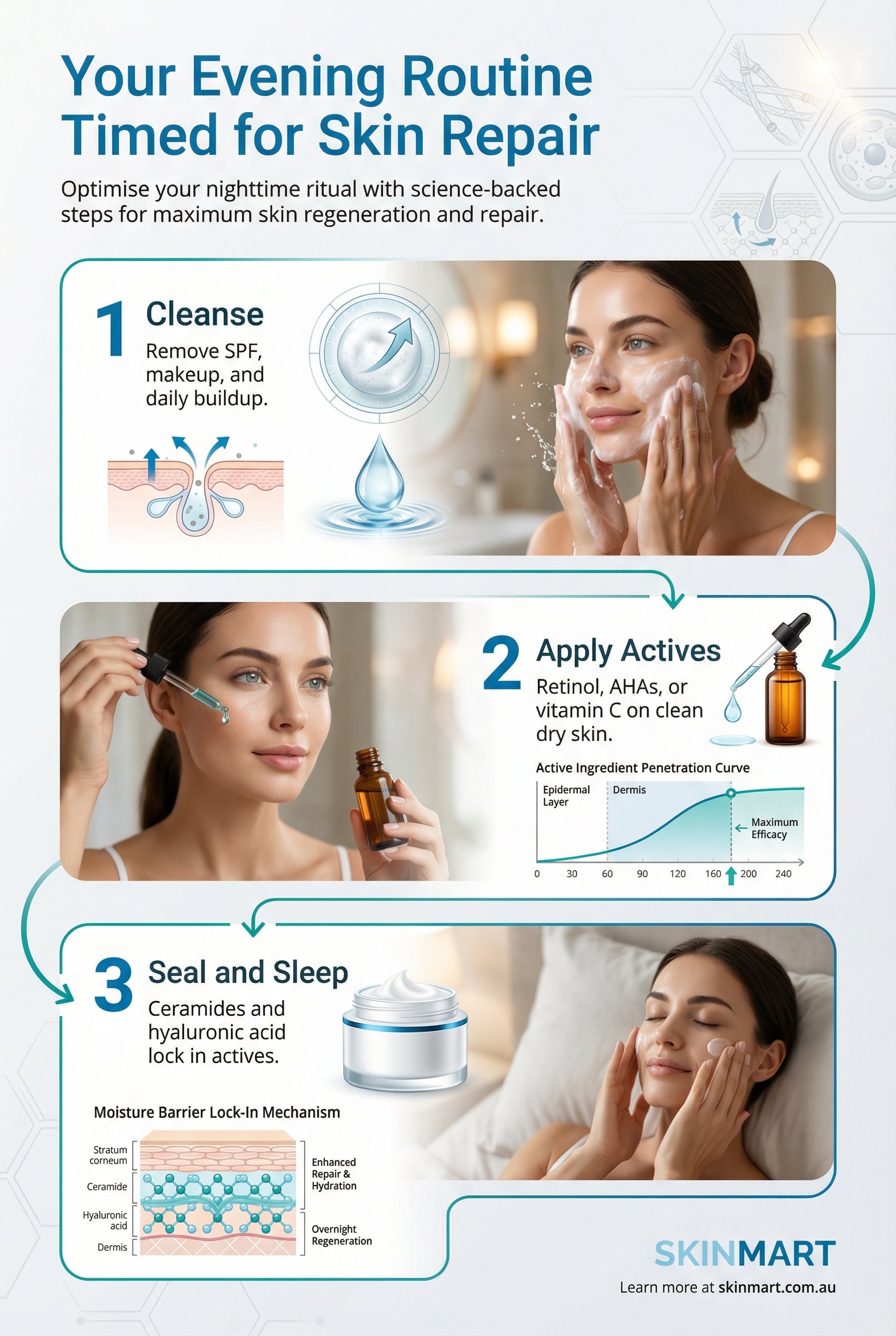
Knowing the biology is one thing. Putting it into practice is where the real benefit comes. Your evening routine does not need to be complicated. It just needs to be timed and layered well. Here is a simple framework that works with your skin's natural overnight cycle.
Step 1: Cleanse thoroughly. Your skin has spent all day collecting sunscreen, pollution, and dead cells. A proper cleanse clears the path for everything that follows. If you wear SPF or makeup, a double cleanse works well. Start with an oil-based cleanser, then follow with a gentle water-based one. A pre-cleanse balm is a great first step for breaking down SPF and makeup well.
Step 2: Apply your actives. This is where ingredients like retinol, AHAs (alpha hydroxy acids, which are gentle exfoliating acids), or vitamin C serums go. Apply these to clean, dry skin. Thinner products go on before thicker ones.
If you are using retinol, start slowly. Two to three nights per week is enough when you are new to it. Your skin needs time to adjust.
Step 3: Seal with a moisturiser or sleep mask. A good night moisturiser or sleep mask locks in your actives and helps reduce the TEWL we mentioned earlier. Look for ingredients like ceramides (natural fats that hold your skin barrier together, like mortar between bricks), hyaluronic acid (a moisture-binding molecule that holds up to 1,000 times its weight in water). And niacinamide (a form of vitamin B3 that calms swelling and supports barrier function).
Timing matters too. Try to apply your routine at least 30 minutes before sleep. This gives actives time to absorb before your face hits the pillow. Aim to be asleep before midnight so your skin can make the most of the 11 PM to 4 AM repair window.
Beauty sleep is one of the most underrated tools in skincare. While you rest, your skin runs a full repair cycle. Cortisol drops, growth hormone rises, cell turnover speeds up, and DNA damage gets patched.
Your skin is more absorbent at night, which means your evening routine has more impact than your morning one. Getting the timing and layering right does not require a complicated routine. It just requires understanding what your skin is actually doing and working with it.
If you want to take confident control of your skin journey, start with the basics. Sleep well. Cleanse properly. Apply your actives at night.
Seal with a good moisturiser. Those four steps, done consistently, will do more for your skin than any trending product applied at the wrong time. Your skin is already doing the hard work. Your job is to give it the right conditions to succeed.


