
If you've spent any time researching skincare ingredients, you've likely heard it: don't use niacinamide and vitamin C together. They'll cancel each other out. They'll turn your skin red. They're incompatible.
Here's the truth: this myth has been circulating for decades, and it's based on research that has nothing to do with how modern skincare works. Not only can you use niacinamide and vitamin C together, when formulated correctly, they actually work beautifully as a team. One brightens and protects, the other strengthens and calms. Together, they address multiple skin concerns better than either ingredient alone.
Let's break down where this myth came from, what the science actually says, and how to layer these two powerhouse ingredients correctly.
Where Did This Myth Come From?
The niacinamide-vitamin C incompatibility myth traces back to a 1960s study that examined what happens when you mix pure niacin (nicotinic acid) with pure ascorbic acid (vitamin C) in very specific laboratory conditions, high heat, low pH, and extended periods of time.
Under those conditions, the two ingredients did react to form nicotinic acid, which can cause temporary flushing. But here's what matters: that study used niacin, not niacinamide. These are different forms of vitamin B3 with different chemical structures and different behaviours on skin.
Niacinamide is far more stable than niacin. It doesn't convert to nicotinic acid under normal skincare conditions. Modern vitamin C formulas are pH-balanced and stabilised. Your bathroom shelf isn't a 1960s chemistry lab operating at extreme temperatures.
The myth persists because it sounds scientific enough to be believable, and because skincare brands sometimes perpetuate it, often to sell you separate morning and evening routines. But the evidence doesn't support the fear.
What Does the Science Actually Say?
Recent research paints a completely different picture. Multiple studies have examined niacinamide and vitamin C used together in real-world skincare formulas, and the results are consistently positive.

A 2020 study published in the International Journal of Cosmetic Science found that combining niacinamide with vitamin C in topical formulas was not only safe but showed enhanced benefits for skin barrier function and pigmentation reduction compared to either ingredient used alone.
Another study examining the stability of combined formulas found that when properly formulated at appropriate pH levels (typically between 5.0 and 6.0), niacinamide and vitamin C remain stable and effective for months of shelf storage.
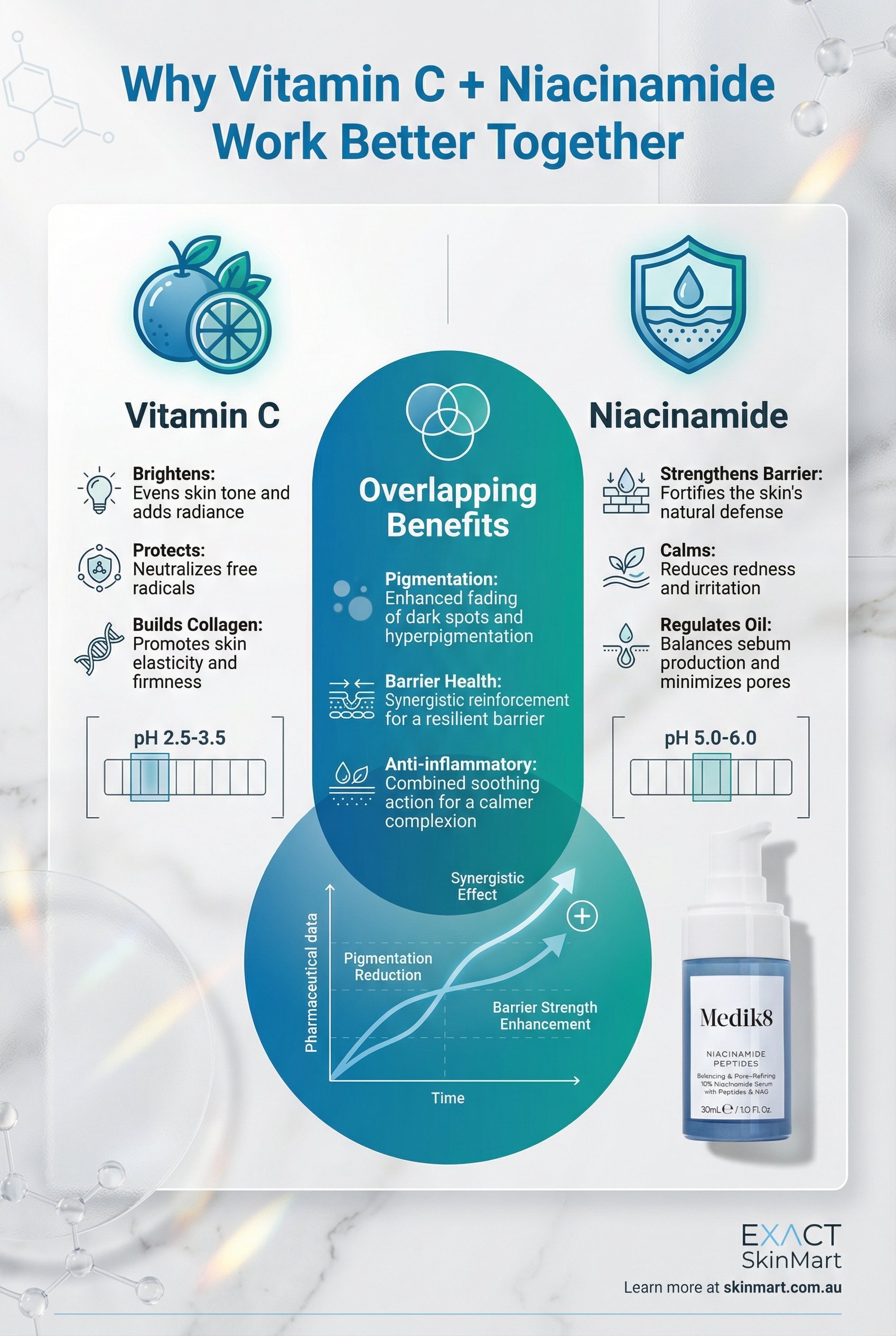
Here's what actually happens when you use both ingredients: Vitamin C works as a potent protector, neutralising free radicals and inhibiting melanin production. It brightens existing pigmentation and protects against environmental damage. Niacinamide strengthens your skin barrier, reduces swelling, regulates oil production, and also helps fade pigmentation through a different pathway, it prevents melanin transfer from melanocytes to skin cells.
They're not competing. They're complementing each other, addressing skin concerns from multiple angles at once.
Key Takeaways
- You can safely use niacinamide and vitamin C together.
- The myth that they cancel each other out stems from outdated 1960s research using pure niacin, not niacinamide.
- Modern formulas are pH-stable and designed to work in tandem.
- When layered correctly, vitamin C first, then niacinamide, they complement each other beautifully.
- Vitamin C brightens and protects while niacinamide strengthens your barrier and calms swelling.
How to Layer Niacinamide and Vitamin C Correctly
Understanding that these ingredients work well together is one thing. Knowing how to layer them for maximum effectiveness is another.
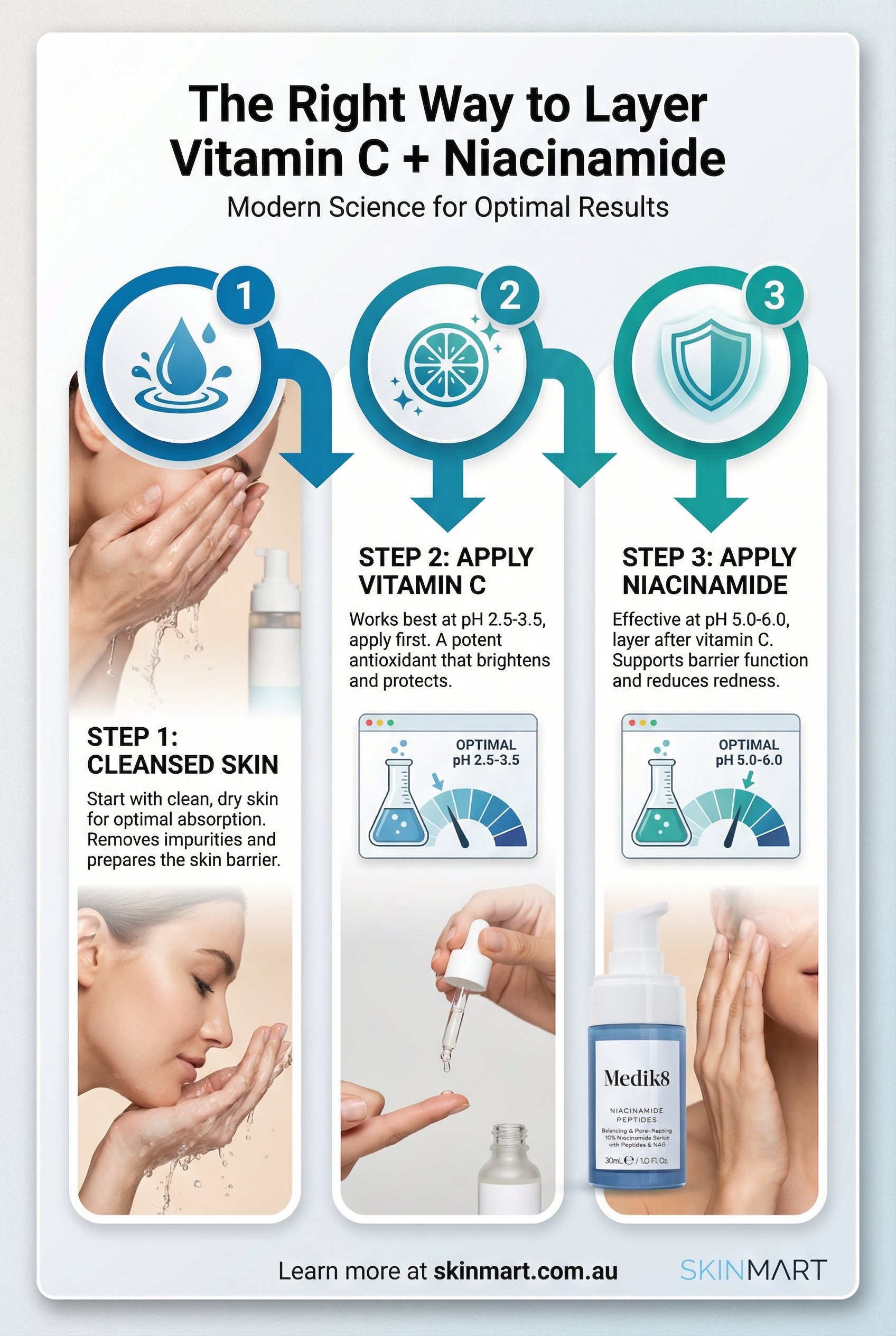
The general principle: apply vitamin C first, then niacinamide. Here's why this order matters.
Vitamin C (especially L-ascorbic acid, the most researched form) works best at a lower pH, typically between 2.5 and 3.5. This acidic environment allows it to reach well and remain stable. Niacinamide, on the other hand, is effective across a wider pH range and is typically formulated between 5.0 and 6.0.
By applying vitamin C first on clean skin, you give it the best pH environment to work. After it absorbs (wait 1-2 minutes), you can apply niacinamide. The slight pH increase won't deactivate the vitamin C that's already penetrated, and niacinamide will work perfectly well at this stage.
If you're using a vitamin C derivative rather than pure L-ascorbic acid, such as sodium ascorbyl phosphate or magnesium ascorbyl phosphate, the pH concern is even less relevant. These derivatives are stable at higher pH levels, making them even more compatible with niacinamide.
One practical note: if you're new to active ingredients or have sensitive skin, you might prefer to use vitamin C in the morning and niacinamide in the evening, at least at first. Not because they're incompatible, but simply to introduce your skin gradually to multiple actives. Once your skin adjusts, layering them together is perfectly fine.
Why This Combination Is especially Effective
When you understand what each ingredient does, the logic of combining them becomes clear.

For pigmentation: Vitamin C inhibits tyrosinase, the enzyme responsible for melanin production. Niacinamide prevents melanin transfer to skin cells. You're addressing pigmentation at two different stages of the process, which means more complete results than using either ingredient alone.
For barrier health: Vitamin C supports collagen synthesis and protects against oxidative stress. Niacinamide increases ceramide production and strengthens the lipid barrier. Together, they build a more resilient skin barrier that's better equipped to handle environmental stressors.
For swelling: Both ingredients have anti-inflammatory properties, but they work through different mechanisms. Vitamin C neutralises free radicals that trigger inflammation responses. Niacinamide reduces the production of inflammation cytokines. The combined effect is especially helpful for sensitive or reactive skins.
For overall skin health: Vitamin C provides protective protection during the day when your skin faces UV exposure and pollution. Niacinamide regulates oil production, minimises pores, and supports barrier repair, benefits that compound over time with consistent use.
This isn't about using more ingredients for the sake of it. It's about strategic layering that addresses multiple aspects of skin health at once.

Featured: Niacinamide Peptides
Clinically proven 10% niacinamide serum that dramatically improves the look of pores and congestion while soothing the skin barrier.
Shop NowWhat About Product formula?
Here's something that matters more than the myth: formula quality.
Not all vitamin C serums are created equal. L-ascorbic acid is notoriously unstable, it oxidises when exposed to light, air, and water. A poorly formulated vitamin C serum will turn yellow or brown, indicating oxidation, and won't deliver the benefits you're expecting.
Look for vitamin C products in opaque, airless packaging. Check the amount, research shows effectiveness at 10-20% for L-ascorbic acid. If you have sensitive skin, consider starting with a vitamin C derivative, which tends to be gentler while still providing protective benefits.
For niacinamide, stability is less of a concern, it's a very stable ingredient. The effective amount range is typically 2-10%.
When choosing products to layer, pay attention to texture. A lightweight vitamin C serum followed by a slightly richer niacinamide serum works well. If both products are very thick or contain high levels of silicones, they may not layer smoothly, not because of ingredient incompatibility, but simply because of texture issues.
Products like Medik8's Niacinamide Peptides are formulated with layering in mind. At 10% niacinamide with added peptides for collagen support, it's designed to work as part of a complete routine, not in isolation. You can confidently layer it over your vitamin C serum without worrying about interactions.
When Separation Might Actually Make Sense
While niacinamide and vitamin C are compatible, there are practical reasons you might choose to separate them, and none of them have to do with the debunked myth.
Sensitive skin introduction: If you're new to active ingredients, introducing one at a time helps you monitor how your skin responds. Start with niacinamide (it's usually gentler), use it consistently for 2-3 weeks, then add vitamin C. This approach isn't about incompatibility, it's about giving your skin time to adjust.
Routine simplification: Some people prefer a streamlined morning routine and a more treatment-focused evening routine. Using vitamin C in the morning (when you need protective protection most) and niacinamide in the evening (when barrier repair happens) is a perfectly valid approach.
Product texture preferences: If your vitamin C serum and niacinamide product don't layer well due to texture or silicone content, separating them by time of day solves the practical issue without sacrificing the benefits of either ingredient.
The point is this: if you choose to separate these ingredients, do it for practical reasons that make sense for your skin and routine, not because you're afraid they'll cancel each other out.
The niacinamide and vitamin C incompatibility myth is exactly that, a myth. It's based on outdated research that doesn't reflect how modern skincare formulas work or how you actually use these products on your skin.
The truth is far more useful: these two ingredients complement each other beautifully. Vitamin C brightens, protects, and supports collagen. Niacinamide strengthens your barrier, calms inflammation, and addresses pigmentation through a different pathway. Together, they give you more complete results than either ingredient alone.
If you've been avoiding this combination because of the myth, you now have the evidence to layer them confidently. Apply vitamin C first, let it absorb, then follow with niacinamide. Choose well-formulated products that are stable and appropriately concentrated. And if you prefer to separate them for practical reasons, routine simplification, sensitive skin introduction, or texture preferences, that's fine too.
What matters isn't following skincare rules based on outdated science. What matters is understanding how ingredients actually work, so you can build a routine that makes sense for your skin.


