
You have done the research. You found a retinol that works, a peptide serum with solid reviews, and a collagen cream your skin seemed to love. For a while, things were moving in the right direction.
Then, somewhere around your mid-forties, the results slowed. Not because the products stopped working. But because something deeper shifted first.
NAD+ and collagen are more connected than most skincare advice lets on. Understanding that connection could explain why your routine has plateaued, and what you could add to get more from the products you already trust.

What Is NAD+ and Why Does It Matter for Ageing Skin?
NAD+ (nicotinamide adenine dinucleotide) is a molecule found in every cell in your body. Think of it as cellular fuel. Your skin cells use it to produce energy, repair DNA damage, and run the biological processes that keep skin looking healthy and firm. Without enough NAD+, those processes slow down.
Here is the part that changes everything: NAD+ levels drop by roughly 50% between the ages of 40 and 60. This is not a minor dip. It is a major decline that affects how well your skin cells can function. Your fibroblasts (the cells responsible for making collagen and elastin) are especially affected. When their energy supply drops, so does their output.
This is not about your skincare routine failing you. It is about a cellular shift that happens regardless of what you apply topically. The good news is that this shift is something you can actively support.
How Does NAD+ Decline Affect Collagen Production?
Collagen is a structural protein. It gives your skin its firmness and bounce. Your fibroblasts build it constantly, but they need energy to do so.

That energy comes from ATP, which your mitochondria (the powerhouses inside each cell) produce using NAD+. Less NAD+ means less ATP. Less ATP means your fibroblasts cannot synthesise collagen as efficiently.
There is another layer to this. NAD+ activates a group of proteins called sirtuins, including SIRT1. When SIRT1 is active, it supports collagen synthesis and helps regulate swelling. When NAD+ drops, sirtuin activity drops with it. The result is slower collagen production and a gradual loss of the structural support that keeps skin looking lifted and firm.
This also explains why skin often loses its ability to recover. After sun exposure, stress, or a late night, younger skin bounces back quickly. Older skin takes longer. That delayed recovery is partly a sign of reduced cellular energy, not just surface-level damage. If you want to understand more about how your skin repairs itself overnight, this article on circadian rhythm and skin covers the repair cycle in detail.
Why Do Good Products Stop Delivering Results?
Retinoids are one of the best-studied ingredients in skincare. They stimulate cell turnover and signal your skin to produce more collagen. Peptides send similar signals.
Both are evidence-based and genuinely effective. But here is the thing: they work by telling your fibroblasts what to do. If those fibroblasts are running low on cellular energy, they cannot fully respond to the signal.
Think of it this way. If you send a clear instruction to a factory that has no power, the instruction does not help. Your retinol and peptides are sending the right messages.
NAD+ decline affects whether your cells have the energy to act on them. This is not a reason to abandon your routine. It is a reason to support the cellular foundation that makes your routine more effective.
If you are new to retinol or wondering how it fits into a broader plan, that guide is a useful starting point alongside what you learn here.
What Does the Science Say About NAD+ and Skin?
The research on NAD+ and ageing is growing fast. A study by Martens et al. (2018) found that 1000mg of nicotinamide riboside (an NAD+ precursor) daily raised NAD+ levels by 60% in healthy adults over six weeks. Gehring (2004) showed that topical niacinamide at 5% improved fine lines, skin tone, and elasticity over 12 weeks. Bissett et al. (2005) confirmed similar results, with continued improvements throughout the trial period.

Niacinamide (vitamin B3) is an NAD+ precursor. It enters the salvage pathway, which is the main route your cells use to renew NAD+. At 5%, it has strong clinical backing for barrier improvement, pigmentation reduction, and fine line softening. It is also well-tolerated across most skin types, including sensitive skin. This makes it the most practical starting point for topical NAD+ support.
CoQ10 (coenzyme Q10) supports a different part of the process. It helps your mitochondria produce energy more efficiently and protects against oxidative stress. Knott et al. (2015) found a 27% reduction in wrinkle depth after six months of topical CoQ10 use. These are not dramatic overnight changes, but they reflect real improvements in how cells are functioning.

Featured: FutureCode Booster
Advanced booster that helps extend the longevity of healthy-looking skin by supporting natural skin repair and reducing visible signs of DNA-relate...
Shop NowHow to Support NAD+ Levels Without Starting From Scratch
You do not need to rebuild your routine. NAD+ support works alongside the treatments you already use. The goal is to give your cells the energy to respond more fully to what you are already applying.
Start with a niacinamide serum at 5%. Apply it twice daily after cleansing, before your retinol or peptides. It is stable, compatible with most actives, and backed by solid clinical evidence.
In the morning, pair it with a CoQ10 formula to support mitochondrial function and add protective protection. This matters especially in Australia, where UV exposure is high. UV damage depletes NAD+ through DNA repair processes.
Every day without SPF 50+ broad-spectrum protection works against the cellular support you are building. Photoprotection is not optional here. It is part of the strategy.
Expect gradual progress. Texture and radiance often improve within three to four weeks. Firmer-feeling skin and visible fine line changes take eight to twelve weeks. Structural improvements in dermal density can take three to four months.
This is how real cellular change works. It builds quietly, then becomes visible. For a broader look at how active ingredients work together, this guide on supercharging your routine is worth reading alongside this one.
Key Takeaways
- NAD+ is a molecule your skin cells need to produce collagen.
- After 40, NAD+ levels drop by about 50%.
- When this happens, your fibroblasts (the cells that make collagen) lose the energy they need to work properly.
- This is why good products can stop delivering results over time.
- Supporting NAD+ levels through ingredients like niacinamide gives your cells the energy to respond to the treatments you are already using.
FutureCode Booster: NAD+ Support in Serum Form
Most NAD+ support products come in heavy creams. The Dermalogica FutureCode Booster delivers this support in a lightweight serum format. That matters because it layers easily under your existing moisturiser and SPF without disrupting the routine you have already built.
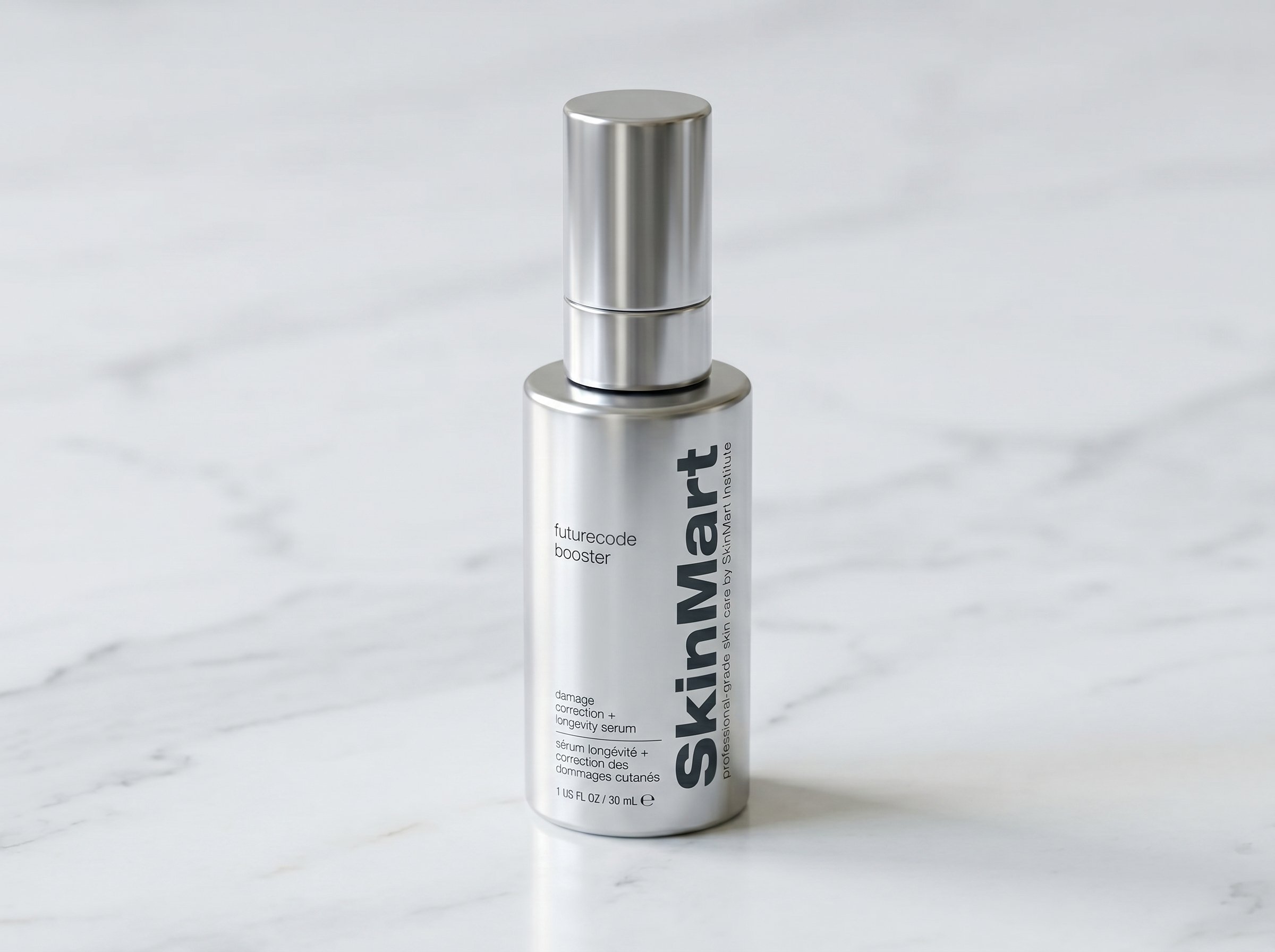
The key ingredients work together across several pathways. Teprenone supports cellular longevity and helps reduce visible signs of DNA-related damage. Niacinamide provides NAD+ precursor support and barrier strengthening.
Helianthus annuus (sunflower) sprout extract adds protective protection at the cellular level. Acetyl zingerone helps manage oxidative stress. Rosehip oil (Rosa canina seed oil) supports skin repair and delivers essential fatty acids for barrier health.
This is not a replacement for your retinol or peptide serum. It is a foundational layer that supports the cellular environment those actives work within. Think of it as optimising the conditions for your existing routine to perform at its best. Shop FutureCode Booster now.

What Realistic Progress Looks Like Over Time
One of the most common frustrations in skincare is not seeing fast results and assuming something is not working. With cellular support, the timeline is different from surface-level hydration or instant-glow products. The changes are happening at a metabolic level first, then becoming visible over weeks and months.
Weeks one to four: Your skin barrier often improves first. You may notice better hydration retention and a slight improvement in radiance. This reflects NAD+ supporting ceramide production and barrier function. Weeks four to eight: Texture smooths and tone becomes more even.
Fine lines around the eyes often soften during this phase. Months two to four: Firmer-feeling skin and visible improvements in the areas where loss of structure is most noticeable. These changes reflect improved fibroblast function and increased collagen output over time.
This is not about instant transformation. It is about supporting the cellular processes that determine how well your skin ages. The difference between skin that ages with resilience and skin that loses structure quickly often comes down to what is happening at this level. Genetics play a role in ageing, but cellular energy support is one of the factors you can actively influence.
Your routine is not failing. The products you trust are still doing their job. But if your skin has stopped responding the way it used to, NAD+ decline is worth understanding. It is not a flaw in your approach. It is a cellular shift that happens with age, and one you can actively support.
Start with what is evidence-based: niacinamide at 5%, daily SPF 50+, and a product designed to work at the cellular level. The FutureCode Booster is built for exactly this. If you want to understand how your skin is ageing and what your routine could be doing better, speak to our skin experts to understand exactly where this fits in your routine.


