You have probably tried a rich moisturiser. Maybe a ceramide cream. Perhaps a barrier serum that promised to fix the dryness for good. And for a day or two, your skin felt better.
Then it went back to feeling tight, rough, or thirsty again. That cycle is not a product problem. It is a production problem.
Chronic dryness often comes down to one thing: your skin has stopped making enough ceramides (natural fats that form the protective barrier between your cells) on its own. Applying them topically helps in the short term. But if the underlying production process stays broken, you are just topping up a leaking tank. Understanding whether your skin is truly dry or dehydrated is a useful first step. This post goes one level deeper, explaining how Exo-PDRN Prismatic+ targets the root cause of ceramide loss and what the clinical evidence actually shows.
Why Does Your Skin Stop Making Ceramides?
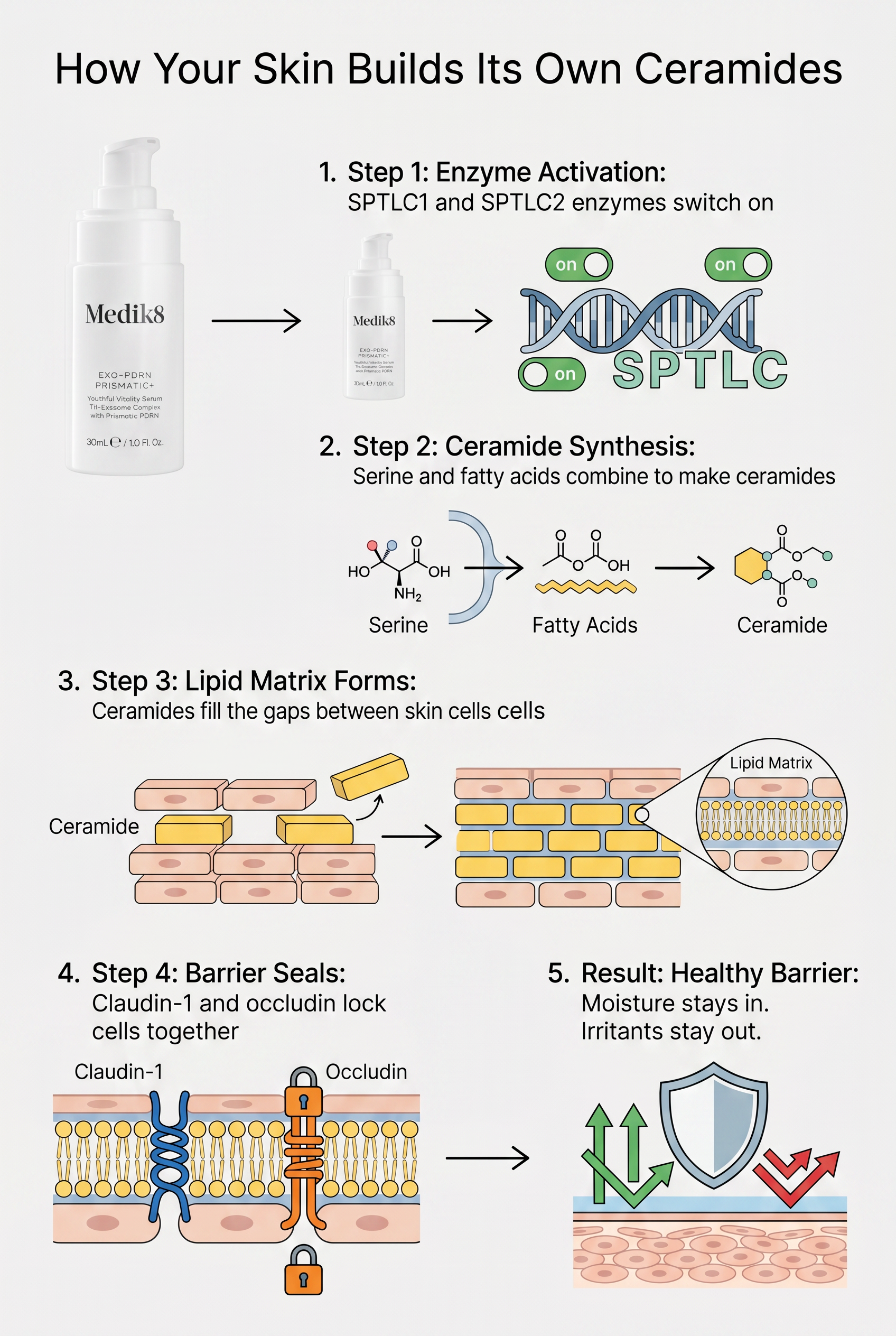
Ceramides make up about 50% of the lipids (fats) in your stratum corneum, which is the outermost layer of your skin. Think of them as the mortar between bricks. Without enough mortar, the wall lets in water, wind, and irritants. Your skin feels dry, tight, and reactive because the structure holding everything together has weakened.
Your skin produces ceramides through a biological pathway called ceramide synthesis. Two enzymes, SPTLC1 and SPTLC2 (serine palmitoyltransferase subunits), start this process. They combine simple building blocks, mainly serine and fatty acids, into the ceramides your barrier needs. When these enzymes work well, your barrier repairs itself naturally. When they slow down, ceramide levels drop.
Several things slow this process. Age is the most common factor, with synthesis efficiency declining gradually from your mid-20s. Environmental stress, harsh cleansers, and UV exposure from the Australian sun all accelerate ceramide breakdown. The result is a barrier that cannot keep up with its own losses. Australian winters make this worse, as cold, dry air strips moisture from already compromised skin.
What Makes Barrier Rebuild Different From Barrier Support?
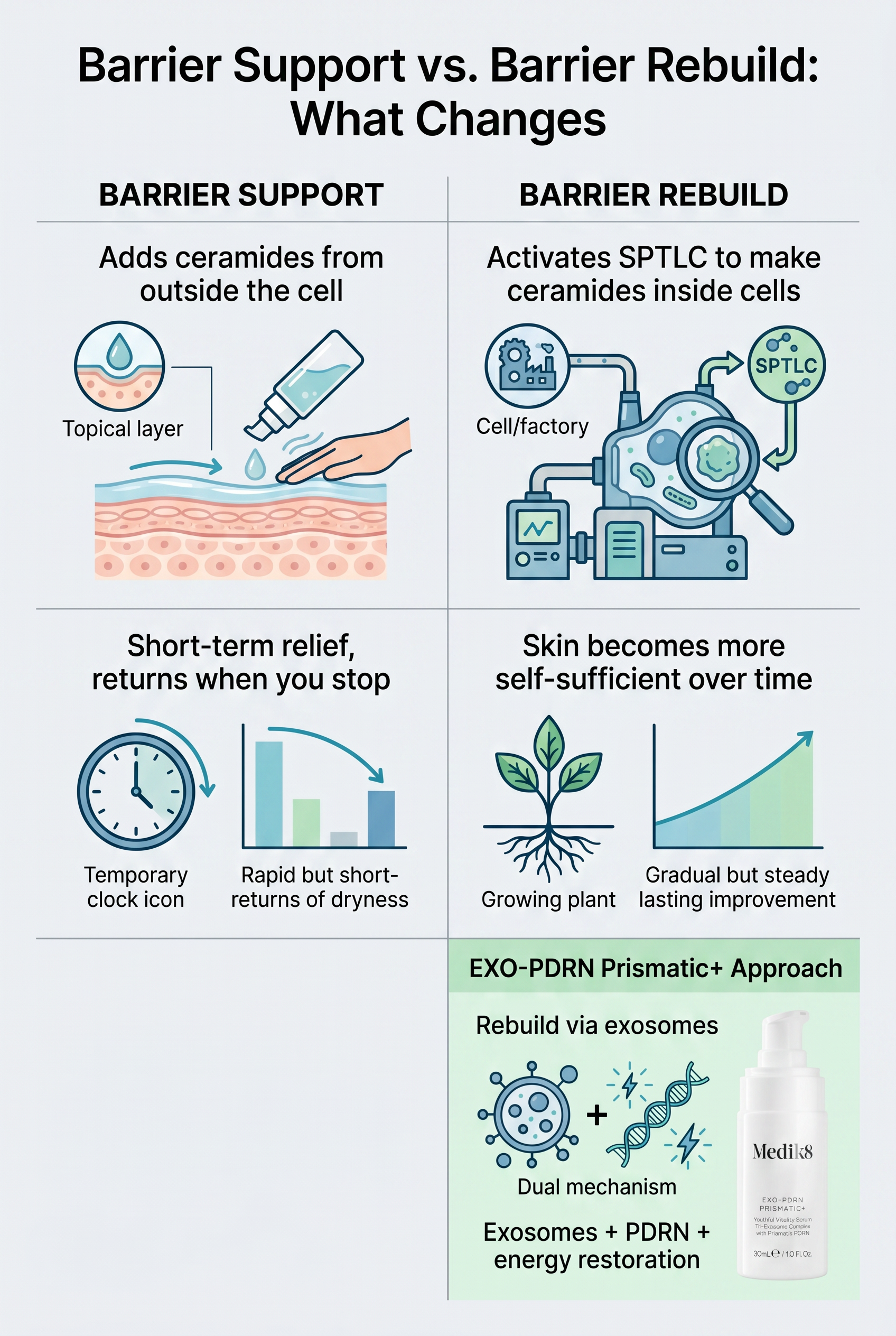
Most ceramide products work by delivering ceramides directly to your skin. This is called barrier support, and it genuinely helps. Your skin absorbs the ceramides, fills some of the gaps in the lipid matrix, and temporarily feels better. The problem is that your skin is still not producing its own ceramides at a healthy rate. Stop using the product, and the barrier weakens again.
Barrier rebuild is a different approach. Instead of just supplying ceramides, it targets the biological process that creates them. If you can restore SPTLC1 and SPTLC2 activity, your skin starts making ceramides on its own again. The barrier becomes more self-sufficient over time, not just temporarily patched.
This distinction matters for people with chronic dryness. If your skin has forgotten how to hydrate itself, adding more ceramides from outside is a short-term fix. Restoring the synthesis pathway is a long-term solution. Our analysis suggests this is why some people see strong initial results from ceramide creams but plateau quickly. The production problem stays unsolved.
Key Takeaways
- Exo-PDRN Prismatic+ restores ceramide production by activating SPTLC1 and SPTLC2, the enzymes your skin uses to make ceramides from scratch.
- Most barrier products simply add ceramides on top.
- This one teaches your skin to produce them again.
- Clinical data shows measurable barrier improvements within 7 days.
- The mechanism works through a Triple Exosome Complex combined with Prismatic PDRN, which delivers repair signals directly to skin cells and restores the biological process behind ceramide...
How Does Exo-PDRN Prismatic+ Restore Ceramide Production?
Exo-PDRN Prismatic+ combines two key technologies: a Triple Exosome Complex and Prismatic PDRN (Polydeoxyribonucleotide). Each plays a specific role in restoring your skin's ability to produce ceramides.
Exosomes are tiny messenger particles released by cells. They carry instructions between cells, telling them to activate certain repair processes. The Triple Exosome Complex in this formula has been shown in ex vivo studies (lab studies using real skin tissue) to boost cell activity by over 50%. Crucially, exosomes can carry signals that upregulate, meaning switch on or increase, SPTLC1 and SPTLC2 activity. This is what drives ceramide synthesis from within the cell, not just on the surface.
Prismatic PDRN is a form of polydeoxyribonucleotide, a molecule derived from DNA fragments that activates adenosine receptors on skin cells. Adenosine receptors are involved in energy production and cellular repair. When activated, they help restore ATP (adenosine triphosphate), which is the energy your cells need to run biological processes, including ceramide synthesis. Without enough cellular energy, even healthy SPTLC enzymes cannot do their job properly. PDRN addresses this energy deficit directly.
Together, these two mechanisms target ceramide production at the cellular level. The exosomes deliver the signal to upregulate synthesis enzymes. The PDRN restores the energy needed to act on those signals. Clinical data shows measurable improvements in barrier function within 7 days, with ongoing gains in skin health, luminosity. And tone continuing through the first two weeks of use.
What About Tight Junction Proteins?
Ceramides are only part of the barrier story. Your skin also relies on tight junction proteins called claudin-1 and occludin to seal the spaces between cells. Think of these as the locks on the doors between skin cells. When they are working, water stays in and irritants stay out. When they break down, your barrier leaks even if ceramide levels are reasonable.
Exo-PDRN Prismatic+ has been shown to upregulate both claudin-1 and occludin expression. This means your skin produces more of these sealing proteins, which strengthens the barrier from a second angle. Ceramide production handles the lipid matrix. Tight junction protein production handles the cellular seals. Both need to work together for a truly resilient barrier.
This dual action is part of what makes this approach different from standard barrier support. You are not just adding ingredients to the surface. You are restoring two separate biological systems that together determine how well your barrier holds moisture and resists external stress. Pairing this with a well-structured routine helps you get the most from both mechanisms.

Featured: Exo-PDRN Prismatic+
A full-spectrum face serum that boosts skin's natural rejuvenation by over 50%.
Shop NowWho Is This Right For?
Exo-PDRN Prismatic+ is a strong fit for people with chronic dryness who have tried ceramide moisturisers and found the results short-lived. If your skin feels tight again within hours of applying a rich cream, that is a sign your barrier production is not keeping up. This formula targets that root cause.
It is also well suited to skin experiencing dryness from environmental stress, age-related barrier decline, or the aftermath of active treatments. Clinical data shows 98% agreement on post-procedure efficacy, which means it has been validated for use after procedures that temporarily compromise barrier function. It works without causing additional disruption, which matters when your skin is already under stress.
This product is not the right fit for everyone. People with severely compromised barriers should work with a skin therapist before introducing new active formulas. Those with known sensitivity to nucleotides should also seek guidance first. If you are unsure whether this suits your skin, understanding how active ingredients work for your skin type is a helpful starting point before committing.
How to Add It to Your Routine
Exo-PDRN Prismatic+ works best applied to clean skin before your moisturiser. In the morning, follow with SPF, which is non-negotiable in Australia given our UV levels. In the evening, apply it after cleansing and before any heavier barrier creams or oils. Consistent daily use gives the exosome and PDRN mechanisms time to build on each cell cycle.

You do not need to overhaul your routine to add this. It layers well with most serums and moisturisers. The key is applying it close to clean skin so the exosomes can reach the cells where ceramide synthesis happens. Applying it over thick creams reduces how well it penetrates.
Expect the first signs of improvement around the 7-day mark. Skin typically feels more comfortable and less reactive as barrier function begins to improve. Continued gains in hydration, tone, and resilience develop over the following weeks as ceramide synthesis ramps up and tight junction proteins strengthen the cellular seals.
Chronic dryness is rarely about applying the wrong moisturiser. More often, it is about a barrier that has lost the ability to maintain itself. When ceramide production slows, no amount of topical ceramides will fully compensate. The leaking continues because the production line is still offline.
Exo-PDRN Prismatic+ takes a different approach. By targeting SPTLC1 and SPTLC2 through exosome signalling and restoring cellular energy through Prismatic PDRN, it works to restart the biological process behind ceramide synthesis. Add in the upregulation of claudin-1 and occludin, and you have a formula that addresses barrier weakness from two directions at once. The 7-day clinical data reflects what this kind of root-cause approach can deliver.
If you have been stuck in the cycle of applying and reapplying without lasting change, this is worth understanding more closely. Shop Exo-PDRN Prismatic+ at Skinmart and book a skin consultation to see how it fits your skin's specific needs.


