
You packed away the sunscreen, the beach trips ended, and you figured your skin would settle down. Then, a few weeks into autumn, you noticed it. Dark spots that weren't there in January. A flatness to your skin that no amount of moisturiser seems to shift. Your complexion looks tired, uneven, and just a little defeated.Here's the thing: this is not bad luck. It's biology. Post-summer pigmentation dullness is one of the most common and most misunderstood skin changes of the season. And once you understand what's actually driving it, the path forward becomes much clearer. These are the seven things worth knowing.
Why Does Pigmentation Show Up After Summer Ends?
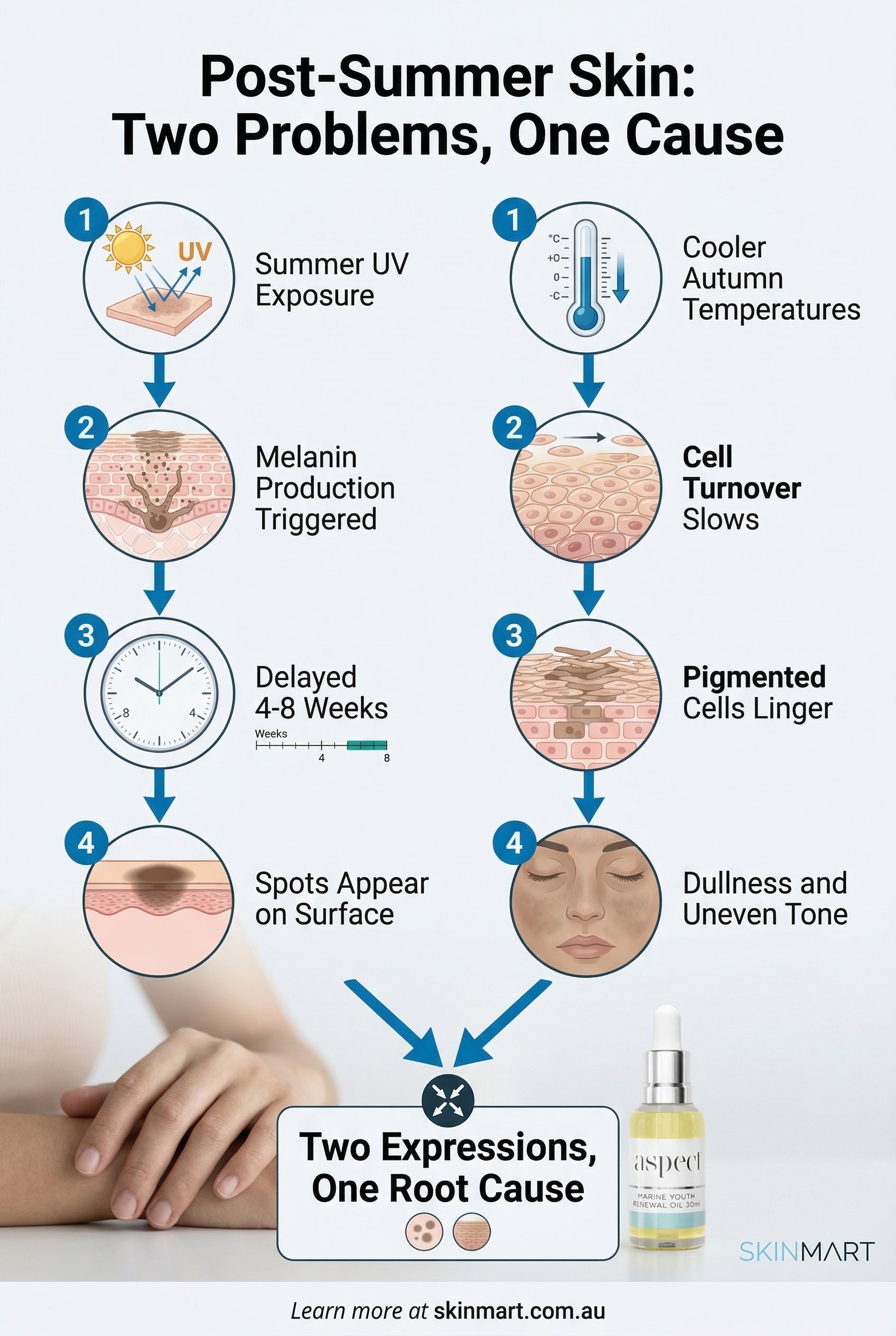
Most people assume sun damage appears during summer. In reality, some of it arrives late. UV exposure triggers your skin to produce melanin (the pigment that gives skin its colour) as a protective response. But melanin production is not instant. The full effect of that summer UV can take weeks to reach the surface of your skin.

So those spots appearing in March or April? They are not new damage. They are summer's damage arriving on a delay. Your skin was quietly processing that UV exposure the whole time. Now it's showing you the result.
This is why so many people feel blindsided by autumn pigmentation. The cause and the visible effect are separated by weeks, which makes the connection easy to miss.
What Is Melanin and Why Does It Cluster Into Spots?
Melanin is produced by cells called melanocytes, which sit in the deeper layers of your skin. When UV light hits the skin, these cells ramp up production as a defence. In healthy, evenly distributed skin, melanin spreads across the surface in a fairly uniform way. But with repeated or intense UV exposure, production becomes uneven. Melanin clusters in certain areas, and that's what creates visible dark spots.

These spots are often called sun spots, age spots, or hyperpigmentation (which just means areas where more pigment has been deposited than the surrounding skin). They are most common on the cheeks, forehead, upper lip, and the backs of hands, areas that get the most sun.
Understanding this helps explain why calming melanin production is such an important part of the solution. You are not just trying to fade what's already there. You are also trying to slow down the production that is still happening beneath the surface.
Key Takeaways
- Post-summer pigmentation appears weeks after sun exposure ends because melanin production is delayed.
- At the same time, skin cell turnover slows in autumn, so pigmented and dead cells linger longer on the surface.
- This creates two visible problems: dark spots and overall dullness.
- These are two expressions of the same root cause.
- The approach that works is gentle resurfacing combined with melanin-calming ingredients, not aggressive peels, which can make pigmentation worse.
Why Does Autumn Make Pigmentation and Dullness Worse?
Here's where the second mechanism comes in. Your skin naturally sheds old cells and replaces them with fresh ones. This process is called desquamation, it's just skin cell shedding. In summer, warmer temperatures and higher humidity tend to keep this process moving at a reasonable pace.
In autumn, cell turnover slows down. The cooler air and lower humidity change the conditions your skin works in. Old, pigmented cells that would normally shed more quickly start to linger on the surface. Dead skin builds up. The result is a skin surface that looks flat, grey, and uneven, even if the underlying skin is healthy.
This is why post-summer skin so often feels dull rather than just spotted. You are dealing with two things at once: delayed pigment arriving from summer UV, and slower cell turnover trapping it at the surface longer. Understanding how seasonal changes affect your skin helps you stay one step ahead of this cycle each year.
Are Pigmentation and Dullness Actually the Same Problem?
In a sense, yes. They share the same root cause. Both come from the combination of UV-triggered melanin production and slowed cell turnover. The difference is just how they show up on your skin.
Pigmentation is localised. You see it as defined dark spots or patches. Dullness is more widespread. The whole surface looks flat and lacks the light-reflecting quality of healthy skin. When pigmented cells and dead skin cells build up together, you get both effects at the same time.
Thinking of them as separate problems leads people toward separate solutions, a spot treatment here, a brightening serum there. But treating the root cause addresses both. That's a more efficient and effective approach to your skin.
Why Are Harsh Peels the Wrong Answer?
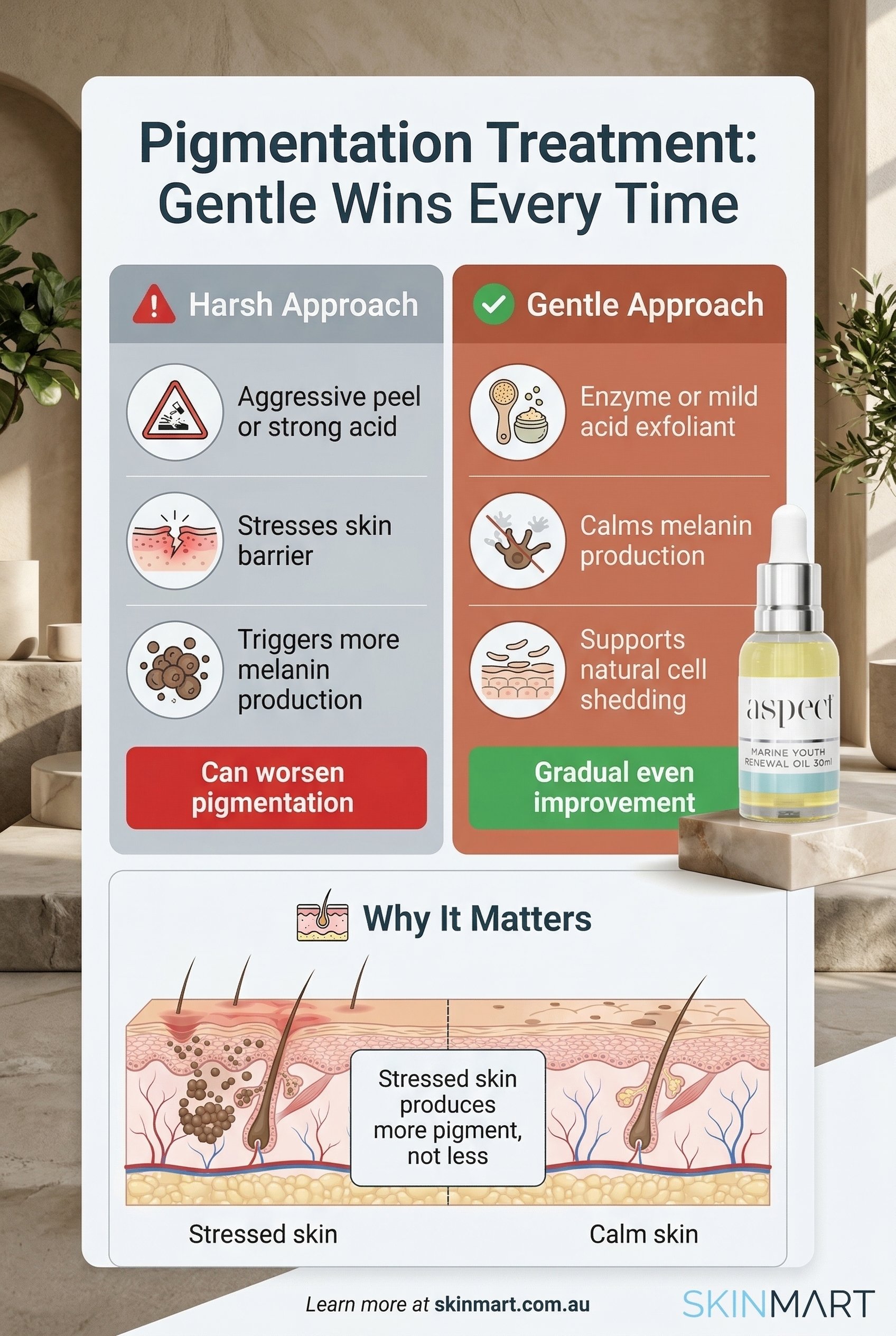
When people see pigmentation, the instinct is often to go hard. Strong chemical peels, aggressive exfoliants, high-strength acids. The logic makes sense on the surface: if the problem is pigment sitting in old skin cells, strip those cells away fast.
But this approach can backfire. Aggressive resurfacing can trigger a stress response in your skin. That stress can actually stimulate more melanin production, the exact thing you are trying to reduce. This is called post-causing swelling hyperpigmentation (PIH), and it is especially common in people with medium to deeper skin tones.
The skin that has just come through a high-UV summer is also more sensitive than usual. Its barrier has taken a hit. Hitting it with a harsh peel at this point can cause irritation, redness, and a worsening of the very spots you were trying to fade. Common exfoliation mistakes often come down to doing too much, too fast.
What Does Actually Work for Post-Summer Pigmentation?
The approach that works is a two-part strategy: gentle resurfacing to support cell turnover, combined with melanin-calming ingredients to address the source of the pigment.

Gentle resurfacing means using mild acids or enzyme exfoliants that encourage old cells to shed without stressing the skin. Think of it as nudging the process along rather than forcing it. Enzyme exfoliants are worth understanding here, they work differently from acids and are often a better fit for sensitised post-summer skin.
Melanin-calming ingredients work by interrupting the steps in melanin production. Vitamin C is one of the most well-researched options. It interferes with the enzyme (called tyrosinase) that drives melanin synthesis.
Niacinamide helps reduce how much melanin transfers to the surface skin cells. These ingredients work best when used consistently over several weeks. Vitamin C in your routine is especially relevant during this post-summer window.
How Long Does It Take to See Results?
This is where honest expectations matter. Pigmentation does not fade in a week. The cells that are currently pigmented need to complete their natural shedding cycle. New, less-pigmented cells need to rise to the surface. This takes time.
Most people start to see a visible shift in skin tone and brightness within four to six weeks of consistent use. More major changes in defined dark spots can take three to four months. The key word is consistent. Skipping days or switching products often resets the process.
Dullness often improves faster than spots, because gentle resurfacing can show results within two to three weeks. That early brightness is a good sign that the approach is working. Stay with it. Brightening ingredients work best as part of a steady, long-term routine rather than a short-term fix.
Post-summer pigmentation and autumn dullness are not two separate problems. They are two expressions of the same thing: delayed melanin arriving from summer UV, combined with slower cell turnover trapping it at the surface. Once you see them as connected, the approach becomes clearer. Gentle resurfacing and melanin-calming ingredients, used consistently, address both.
The most important shift is moving away from the instinct to go hard and fast. Your skin has just come through a high-UV season. It responds better to steady, supportive care than to aggressive treatments. If you're not sure where to start, the Skin Blueprint is designed exactly for this, understanding your skin first, then building a plan that's right for you, not just right in general.


